
Understanding High-Speed Transceiver Tests | 100G & 400G Optical Modules
2026-07-07 10:00:57
Understanding High-Speed Transceiver Tests in Fiber Networks
Why Comprehensive Testing Is Essential for Reliable 100G, 200G, 400G, and 800G Optical Networks
As network speeds continue to evolve from 10G to 25G, 40G, 100G, 200G, 400G, and even 800G, the performance requirements for optical transceivers have become much more demanding.
A transceiver that works perfectly in a laboratory may experience intermittent failures in a real production network if it hasn't been thoroughly tested.
Whether you're deploying a hyperscale data center, enterprise campus network, telecom backbone, or AI computing cluster, testing is no longer optional—it is the foundation of network reliability.
In this article, we'll explain why high-speed optical transceiver testing matters, which tests are most important, and how to choose modules that deliver long-term stable performance.
Why High-Speed Optical Modules Need More Rigorous Testing
At 1G or 10G, networks could often tolerate minor signal degradation.
Today's 100G, 400G, and 800G links are completely different.
High-speed modulation technologies such as PAM4 dramatically increase transmission efficiency but also make modules more sensitive to:
Signal noise
Optical power fluctuations
Temperature variation
Connector contamination
Fiber insertion loss
Compatibility between different vendors
Even a small increase in Bit Error Rate (BER) may eventually cause:
Network instability
Packet retransmissions
Increased latency
Link flapping
Unexpected downtime
This is why leading network operators require extensive testing before deployment.
Common Problems Caused by Poorly Tested Optical Transceivers
Many network engineers have experienced problems such as:
1. Intermittent Link Drops
The link works during installation but disconnects randomly after several hours or days.
Possible causes include:
Unstable laser output
Temperature drift
Weak receiver sensitivity
2. High Bit Error Rate (BER)
Although the link stays online, packet errors continue increasing.
Consequences include:
Reduced application performance
Higher FEC workload
Lower network efficiency
3. Compatibility Issues
Some third-party modules operate correctly in one switch but fail in another.
Compatibility testing with major brands is therefore essential.
Examples include:
Cisco
Juniper
Arista
Huawei
HPE
Dell
Nokia
Extreme Networks
4. Early Hardware Failure
Insufficient burn-in testing may result in failures shortly after deployment.
Replacing failed modules in production environments can be expensive and disruptive.
The Most Important High-Speed Optical Transceiver Tests
1. Optical Power Test
Measures:
Transmit optical power (Tx)
Receive sensitivity (Rx)
Link budget
Purpose:
Ensure stable transmission over the specified distance.
Applicable products:
Cisco QSFP-100G-SR4-S
QSFP-100G-LR4-S
QSFP-100G-DR-S
QSFP-DD-400G-DR4
OSFP 800G DR8
2. BER (Bit Error Rate) Test
BER testing measures transmission accuracy over millions or billions of bits.
Lower BER means:
Better signal quality
Higher network reliability
Lower packet loss
This is one of the most critical indicators for data center networks.
3. Eye Diagram Analysis
Eye diagrams evaluate:
Signal integrity
Timing margin
Noise tolerance
Jitter
This test is especially important for:
25G
50G
100G PAM4
400G
800G
4. Temperature Cycling Test
Optical modules may operate in environments ranging from cold telecom cabinets to hot data centers.
Temperature testing verifies performance under conditions such as:
-5°C
25°C
50°C
70°C
85°C
This helps identify hidden defects before shipment.
5. Compatibility Testing
Professional suppliers validate modules across multiple platforms.
Examples:
Cisco Catalyst
Cisco Nexus
Juniper QFX
Arista 7050 Series
Huawei CloudEngine
Dell PowerSwitch
This reduces deployment risks and installation time.
6. Real Traffic Stress Testing
Laboratory specifications alone are insufficient.
Modules should also be tested under continuous full-load traffic.
Stress testing validates:
Long-term stability
Continuous packet transmission
Error-free operation
Heat dissipation
Typical High-Speed Module Models That Require Comprehensive Testing
The following optical transceivers are widely used in modern networks:
10G
SFP-10G-SR
SFP-10G-LR
SFP-10G-ER
25G
SFP-25G-SR-S
SFP-25G-LR-S
40G
QSFP-40G-SR4
QSFP-40G-LR4
100G
QSFP-100G-SR4-S
QSFP-100G-CWDM4-S
QSFP-100G-PSM4-S
QSFP-100G-LR4-S
QSFP-100G-DR-S
QSFP-100G-FR1
QSFP-100G-BIDI
200G
QSFP56-200G-SR4
QSFP56-200G-FR4
400G
QSFP-DD-400G-SR8
QSFP-DD-400G-DR4
QSFP-DD-400G-FR4
QSFP-DD-400G-LR4
800G
OSFP-800G-SR8
OSFP-800G-DR8
OSFP-800G-2×FR4
Typical Application Scenarios
Data Centers
Reliable optical modules ensure:
Stable east-west traffic
High-density server connectivity
Low latency
Continuous cloud services
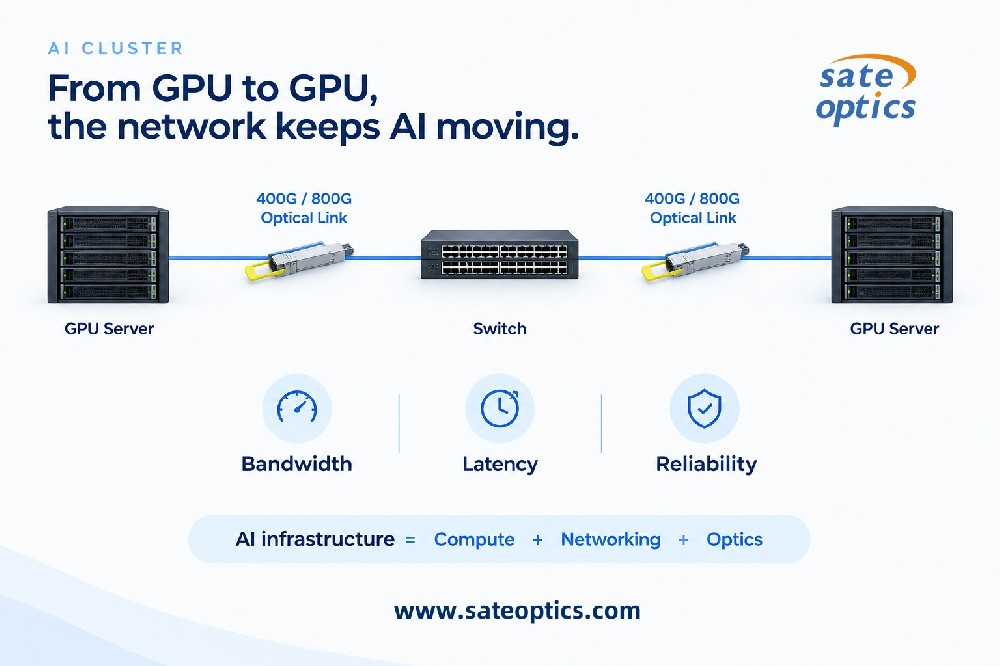
AI Computing Clusters
Large AI models require massive bandwidth.
High-speed tested transceivers support:
GPU clusters
AI training networks
InfiniBand and Ethernet fabrics
Enterprise Campus Networks
Reliable modules reduce maintenance costs while supporting:
Core switches
Distribution switches
Server aggregation
Telecom Networks
Carrier-grade modules are used for:
Metro networks
Backbone transmission
FTTH aggregation
Mobile backhaul
Data Center Interconnect (DCI)
100G, 400G, and 800G modules provide high-capacity links between geographically separated facilities.
How to Choose a Reliable Optical Transceiver Supplier
When evaluating suppliers, don't focus only on price.
Instead, ask whether they provide:
✅ 100% compatibility testing
✅ BER reports
✅ Optical power reports
✅ Eye diagram analysis
✅ Temperature cycling validation
✅ Real traffic testing
✅ Quality traceability
A professional testing process significantly reduces deployment risks and long-term operational costs.
Frequently Asked Questions (FAQ)
Q1. Why is BER testing so important?
BER measures the accuracy of data transmission. Even a small increase in bit errors can lead to packet loss, retransmissions, and reduced network performance, especially in 100G, 400G, and 800G environments.
Q2. Are compatibility tests necessary for third-party optical transceivers?
Yes. Compatibility validation ensures the module operates correctly with switches and routers from vendors such as Cisco, Juniper, Arista, Huawei, Dell, and HPE.
Q3. Does every optical module require temperature testing?
For enterprise, telecom, and data center deployments, temperature testing is highly recommended because environmental changes can affect laser performance and receiver sensitivity.
Q4. What is an eye diagram test?
An eye diagram evaluates signal quality by analyzing jitter, noise, and timing margins. It is especially important for high-speed PAM4 optical transceivers.
Q5. Which applications benefit most from comprehensive transceiver testing?
Data centers, AI clusters, telecom backbone networks, cloud service providers, enterprise campus networks, and Data Center Interconnect (DCI) deployments all benefit from thoroughly tested optical modules.
Conclusion
As networks continue to migrate toward 100G, 400G, and 800G, optical transceiver testing has become a critical part of ensuring network stability, performance, and long-term reliability.
Comprehensive validation—including BER testing, optical power measurement, eye diagram analysis, temperature cycling, compatibility verification, and real-traffic stress testing—helps prevent costly downtime and ensures your infrastructure is ready for demanding production environments.
Choosing a thoroughly tested optical transceiver is not just about meeting specifications—it's about protecting your investment and maintaining uninterrupted network operations.
Contact Sate Optics – Tested for Performance, Trusted for Reliability
At Sate Optics, every compatible optical transceiver undergoes rigorous quality control and performance validation before shipment, including compatibility testing, BER analysis, optical power verification, and real-world stress testing.
Whether you're deploying 10G, 25G, 40G, 100G, 200G, 400G, or 800G networks, we provide reliable, cost-effective solutions compatible with leading brands such as Cisco, Juniper, Arista, Huawei, Dell, HPE, and more.
Looking for high-quality tested optical transceivers? Contact our technical team today for expert advice, product recommendations, and customized networking solutions tailored to your project.
Previous:DAC vs AOC vs Fiber + Optics Buying Guide | How to Choose the Right Data Center Connectivity
Next:AOC vs Fiber Optic Cable: What's the Difference and Which Should You Choose?