
LPO vs CPO vs Pluggable Optics: Key Differences
2026-10-13 21:51:01
LPO vs CPO vs Pluggable Optics: What Are the Key Differences?
As AI workloads continue to grow, data center networks need to move more data while managing power consumption, heat, and signal integrity.
This is why LPO vs CPO vs pluggable optics has become an important topic in high-speed optical networking.
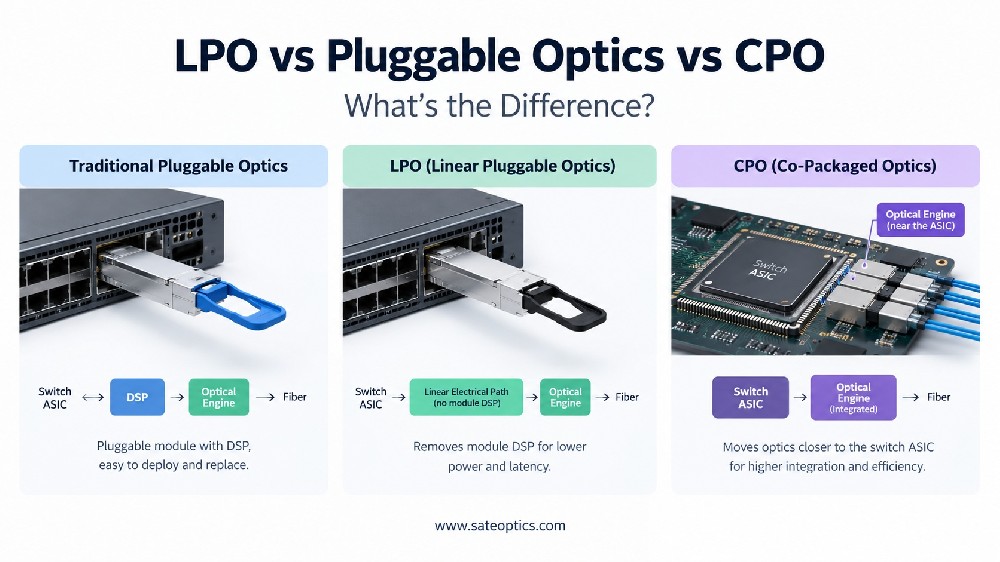
Traditional pluggable transceivers remain a familiar solution for connecting switches, servers, and other network equipment. Meanwhile, Linear Pluggable Optics (LPO) and Co-Packaged Optics (CPO) offer different approaches to reducing the power and electrical challenges associated with increasingly high data rates.
Although all three use optical technology to transmit data, they differ in where signal processing takes place, how optical components are positioned, and how the system is maintained.
Understanding these differences helps network engineers, data center operators, and optical transceiver buyers evaluate which architecture fits their applications.
1. What Are Pluggable Optics?
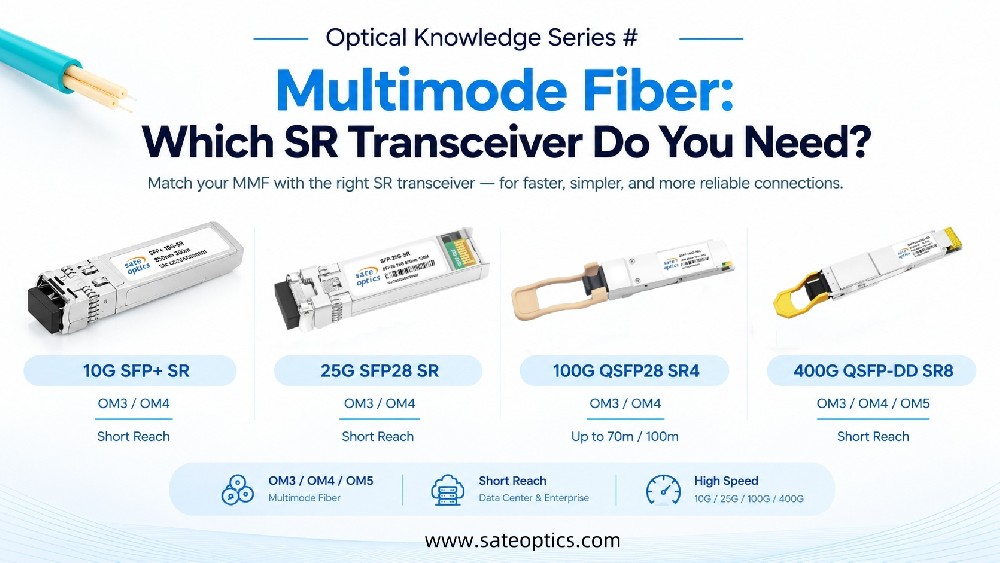
Pluggable optics are removable optical transceivers installed in compatible ports on switches, routers, servers, and other networking equipment.
Common form factors include SFP28, QSFP28, QSFP-DD, and OSFP. Depending on the module, they support different data rates, transmission distances, wavelengths, and fiber types.
In a conventional retimed pluggable transceiver, the module typically contains a digital signal processor (DSP) that helps compensate for electrical signal impairments before transmission and after reception.
The optical engine converts electrical signals into optical signals and converts incoming optical signals back into electrical signals.
Why are traditional pluggable transceivers widely used?
Their main advantage is flexibility.
Replaceability: A failed module can generally be replaced without replacing the entire switch.
Deployment flexibility: Different compatible modules can support different transmission distances and fiber infrastructures.
Upgrade options: Network operators can upgrade selected links as bandwidth requirements change.
Sourcing flexibility: Buyers may have options across different suppliers, subject to platform compatibility and applicable specifications.
These advantages are important in production networks, where maintenance time and operational flexibility affect overall costs.
The trade-off is that conventional retimed modules consume power for signal processing, and the electrical path between the switch ASIC and the front-panel module can become increasingly challenging at higher signaling rates.
2. What Is LPO (Linear Pluggable Optics)?
LPO stands for Linear Pluggable Optics.
LPO retains the pluggable form factor but removes the module-level DSP used in a conventional retimed architecture. The electrical interface follows a more direct, linear signal path between the host and the optical components.
The objective is to reduce power consumption and latency by removing a signal-processing stage.
Key advantages of LPO
Lower power consumption
Removing the module DSP can reduce module power consumption. The actual system-level saving depends on the host platform, optical design, and implementation.
Lower latency
Eliminating DSP processing within the module can reduce latency associated with that processing stage.
Pluggable form factor
LPO retains the physical advantage of a removable module, supporting module replacement and serviceability.
What should buyers consider?
The DSP in a conventional module does not simply perform unnecessary work. It helps compensate for signal impairments.
Without that module-level processing, the host electrical interface, signal quality, and overall system design become more critical.
LPO therefore requires careful validation of the host platform and optical module together. Compatibility should not be assumed simply because the module fits the same port.
LPO is particularly worth evaluating for suitable high-speed, short-reach data center links where power efficiency is a priority and the electrical interface can be well controlled.
3. What Is CPO (Co-Packaged Optics)?
CPO stands for Co-Packaged Optics.
In a CPO architecture, optical engines are integrated close to the switch ASIC within the same package or package-level assembly.
Traditional pluggable optics place the optical interface at the front panel, requiring high-speed electrical signals to travel across the host board. CPO moves the optical conversion point closer to the switching silicon, shortening the high-speed electrical path.
Why is CPO attracting attention?
Shorter electrical paths
Reducing the distance traveled by high-speed electrical signals can help address signal loss and signal-integrity challenges.
Potential power efficiency improvements
Shorter electrical paths can reduce the need for some power-intensive electrical signal conditioning. Actual savings depend on the complete system architecture.
Higher integration density
Integrating optics close to the switching silicon can support high-bandwidth, high-density network designs.
These characteristics make CPO an important architecture for consideration in large-scale AI data centers and other bandwidth-intensive systems.
What are the challenges of CPO?
CPO also changes how networking equipment is designed and maintained.
Serviceability: Optical engines are not replaced like ordinary front-panel transceivers.
Thermal management: Optical engines and high-power switching silicon require coordinated thermal design.
System integration: Packaging, fiber routing, manufacturing, and reliability must be considered together.
Operational planning: Repair and replacement procedures may differ significantly from those used with conventional pluggable modules.
CPO is therefore a system-level architecture decision, not simply another transceiver form factor.
4. LPO vs CPO vs Pluggable Optics: A Direct Comparison
The following comparison summarizes the main architectural differences.
| Feature | Traditional Pluggable Optics | LPO | CPO |
|---|---|---|---|
| Optical placement | Front-panel module | Front-panel module | Close to the switch ASIC |
| Module-level DSP | Typically present in retimed designs | Removed in a linear architecture | Not a conventional front-panel module architecture |
| Power objective | Depends on module and implementation | Reduce module power | Improve system-level power efficiency |
| Latency | Includes module DSP processing where used | Removes module DSP processing latency | Depends on the complete system implementation |
| Electrical path | ASIC to front-panel module | ASIC to front-panel module, with a linear signal path | Shortened by placing optics close to the ASIC |
| Replacement | Module-level replacement | Module-level replacement | More integrated service and replacement process |
| Key consideration | Flexibility and serviceability | Host signal integrity and system validation | Integration, thermal design, and maintenance |
The exact performance of each architecture depends on the product and system design. Power, latency, and reliability figures should be compared using equivalent operating conditions rather than generalized assumptions.
5. LPO vs CPO: Which Is Better for AI Data Centers?
There is no universal winner. LPO and CPO address related challenges through different architectural approaches.
When LPO may be suitable
LPO may be worth evaluating when:
Reducing power consumption at high port counts is a priority.
A pluggable form factor is desirable for maintenance.
The host platform provides a suitable electrical interface.
The network design allows the module and host to be validated as a system.
When CPO may be suitable
CPO may be worth evaluating when:
Very high bandwidth density is required.
Electrical signal paths are becoming a significant design constraint.
System-level power efficiency is a major priority.
The operator can accommodate a more integrated hardware and service model.
Where do traditional pluggable optics fit?
Traditional pluggable transceivers remain practical where replaceability, deployment flexibility, and established operational processes are important.
For many existing networks, a new architecture is not automatically worth adopting unless it solves a specific performance, power, density, or cost problem.
The right comparison should consider the entire network design rather than one optical component in isolation.
6. What Should Buyers Check Before Choosing an Optical Architecture?
Before selecting an architecture for a high-speed network, consider the following questions.
1. What data rate does the application require?
Confirm the port speed, lane configuration, and host interface requirements. A higher headline data rate does not automatically mean a better fit for every link.
2. What transmission distance and fiber type are required?
Check the optical reach, fiber type, connector configuration, and link budget. The physical layer requirements remain important regardless of the architecture.
3. Has interoperability been validated?
For conventional pluggable modules, confirm the target device, coding requirements, and supported specifications.
For LPO, also pay close attention to the electrical interface and host-module combination. For CPO, evaluate system-level integration and the relevant optical interfaces.
4. How will the system be maintained?
Consider the time, cost, and procedures required to diagnose and replace a failed component. The service model can have a significant effect on operating costs.
5. What is the total cost of ownership?
Compare power consumption, cooling requirements, equipment costs, maintenance, and expected upgrade paths. The lowest-power component does not necessarily produce the lowest overall deployment cost.
7. Frequently Asked Questions
Is LPO the same as traditional pluggable optics?
No. LPO retains a pluggable form factor but removes the module-level DSP used in conventional retimed architectures. This changes the electrical signal path and increases the importance of host-module system validation.
Does CPO replace optical transceivers?
CPO changes where optical engines are integrated rather than eliminating optical conversion. It can reduce reliance on conventional front-panel optical modules in the systems that adopt it, but it does not mean all pluggable transceivers will disappear.
Is LPO always more power-efficient than conventional pluggable optics?
Removing the module DSP can reduce module power consumption. However, actual savings depend on the complete implementation, and comparisons should account for the host platform and overall system power.
Is CPO always better than LPO?
No. CPO offers a more integrated architecture, while LPO preserves a removable front-panel module. The appropriate choice depends on bandwidth density, power targets, interoperability, maintenance, and system requirements.
Are traditional pluggable transceivers still relevant for 800G networks?
Yes. Pluggable optics remain an important option for high-speed networking. The suitability of a specific 800G module depends on the host platform, optical reach, fiber infrastructure, and application requirements.
Conclusion
LPO, CPO, and traditional pluggable optics represent different approaches to high-speed optical connectivity.
Traditional pluggable optics emphasize modularity and serviceability. LPO seeks to reduce power and latency while retaining a pluggable form factor. CPO moves optical engines closer to the switching silicon to address electrical path and integration challenges.
As AI data centers continue to scale, the decision will increasingly involve balancing power efficiency, signal integrity, interoperability, and long-term maintenance.
For network engineers and buyers, the most useful question is not simply which architecture is newest, but which one best meets the actual requirements of the network.
At Sate Optics, we focus on optical transceiver solutions for different networking applications, with attention to device compatibility, coding and testing, and dependable supply. When evaluating pluggable transceivers, confirming the target device and link requirements is an important first step.
Need help selecting a compatible optical transceiver for your network? Contact Sate Optics to discuss your device, data rate, transmission distance, and application requirements.
Previous:What Is Return Loss in an SFP? | Sate Optics
Next:No More