
DAC vs AOC vs Fiber + Optics Buying Guide | How to Choose the Right Data Center Connectivity
2026-07-02 16:15:08
DAC vs AOC vs Fiber + Optics: Which Should You Choose?
A Simple Buying Guide
When building or upgrading a network, one question comes up repeatedly:
Should I use a DAC cable, an AOC cable, or Fiber + Optical Transceivers?
Many buyers assume the solution with the longest transmission distance is automatically the best. In reality, choosing the right connectivity solution is about balancing distance, cost, power consumption, flexibility, and future scalability.
This guide provides a simple way to select the right solution based on your application.
Step 1. Start with Link Distance
The easiest way to narrow your options is by considering how far your connection needs to reach.
| Link Distance | Recommended Solution | Typical Application |
|---|---|---|
| Up to 7m | DAC Cable | Same rack or adjacent rack |
| Up to 100m | AOC Cable | Rack-to-rack or row-to-row |
| Up to 300m | Fiber + SR Optics | Enterprise data centers |
| Up to 10km | Fiber + LR Optics | Campus and building-to-building |
| Beyond 10km | ER / ZR / DWDM | Metro and long-distance networks |
While distance is an excellent starting point, it's only one part of the decision.
DAC Cable
Best for Short-Reach Connections (Up to 7m)
Direct Attach Copper (DAC) cables are one of the most cost-effective solutions for high-speed connections over very short distances.
Advantages
Lowest overall cost
Extremely low latency
Very low power consumption
No separate optical transceivers required
Plug-and-play installation
Typical Applications
Top-of-Rack (ToR) switch connections
Switch-to-switch interconnects
Server-to-switch links
High-density data center racks
Typical Products
10G SFP+ DAC
25G SFP28 DAC
40G QSFP+ DAC
100G QSFP28 DAC
400G QSFP-DD DAC
Passive DAC Cable
Active DAC Cable
AOC Cable
Best for Medium-Reach Connections (Up to 100m)
Active Optical Cables (AOC) combine optical fiber with integrated transceivers, offering longer transmission distances than DAC while remaining simple to deploy.
Compared with copper cables, AOCs are lighter, easier to manage, and support higher cable density.
Advantages
Longer transmission distance
Lightweight design
Better airflow inside racks
Simple plug-and-play deployment
Lower cable management complexity
Typical Applications
Rack-to-rack interconnects
Spine-Leaf architectures
AI clusters
Enterprise data centers
Typical Products
10G SFP+ AOC
25G SFP28 AOC
40G QSFP+ AOC
100G QSFP28 AOC
200G QSFP56 AOC
400G QSFP-DD AOC
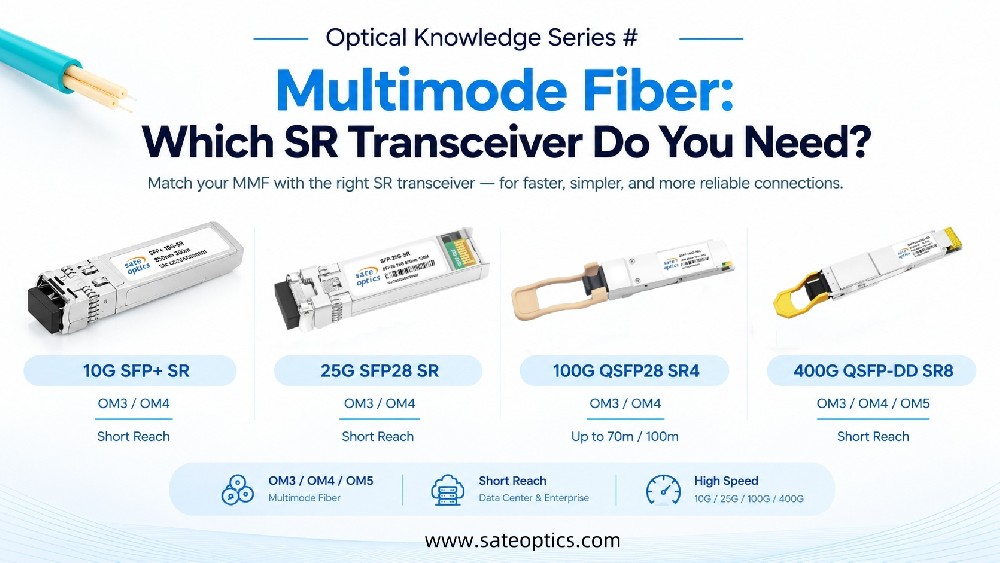
Fiber + SR Optical Modules
Best for Enterprise Data Centers (Up to 300m)
When flexibility becomes more important than integrated cabling, Fiber + SR Optical Modules are often the preferred solution.
Unlike AOC, fiber cables and optical transceivers can be replaced independently, making future upgrades easier.
Advantages
Modular design
Easy maintenance
Flexible upgrades
Supports multimode fiber (MMF)
Suitable for structured cabling systems
Typical Applications
Data centers
Enterprise networks
Storage Area Networks (SAN)
High-performance computing
Typical Products
10G SFP+ SR
25G SFP28 SR
40G QSFP+ SR4
100G QSFP28 SR4
400G QSFP-DD SR8
Fiber + LR Optical Modules
Best for Campus Networks (Up to 10km)
For longer distances, single-mode fiber combined with LR optical transceivers provides an ideal balance between reach and deployment cost.
Advantages
Long transmission distance
High reliability
Easy future expansion
Supports structured campus networks
Typical Applications
Building-to-building connectivity
Campus backbone
Enterprise WAN
Industrial parks
Typical Products
10G SFP+ LR
25G SFP28 LR
100G QSFP28 LR4
400G QSFP-DD DR4
Single-Mode Fiber Optics
Long-Distance Solutions
When transmission distances exceed 10km, standard LR optics are no longer sufficient.
Depending on the application, consider:
10G ER
10G ZR
25G ER
DWDM Optical Transceivers
CWDM Optical Transceivers
Coherent Optics
These solutions are commonly deployed in:
ISP backbone networks
Metro Ethernet
Telecom networks
Long-haul transmission
How to Make the Right Choice
Rather than choosing the highest-specification product, start by asking five simple questions:
How far is the link?
What data rate is required?
Am I using multimode or single-mode fiber?
Is future scalability important?
What is my deployment budget?
In many projects, the simplest solution is also the most cost-effective.
Frequently Asked Questions (FAQ)
1. Is DAC always cheaper than AOC?
Yes. For short-distance connections, DAC cables are generally the lowest-cost option because they do not require separate optical transceivers.
2. When should I choose AOC instead of DAC?
AOC is typically preferred when longer reach, lighter weight, and easier cable management are more important than minimizing cost.
3. When should I choose Fiber + SR instead of AOC?
Choose Fiber + SR when you need greater flexibility, structured cabling, or the ability to replace cables and transceivers independently.
4. Can LR optical modules be used for short-distance links?
Technically yes, but they are usually not the most economical choice. Selecting optics based on the actual application is generally more cost-effective than simply choosing the longest-distance option.
5. Which solution is best for AI and high-density data centers?
It depends on the deployment distance. DAC is ideal for short in-rack connections, AOC works well for rack-to-rack links, while Fiber + SR or higher-speed optical modules are commonly used for larger AI and cloud data center fabrics.
Conclusion
Choosing between DAC, AOC, and Fiber + Optical Transceivers isn't about selecting the product with the longest transmission distance.
It's about selecting the solution that best matches your application, distance, budget, and future expansion plans.
Starting with your real network requirements will almost always lead to a more reliable, cost-effective, and scalable deployment.
Need Help Choosing the Right Connectivity Solution?
Whether you're deploying a new data center, upgrading an enterprise network, or expanding a campus backbone, selecting the right interconnect can reduce costs and simplify future maintenance.
At Sate Optics, we supply a full range of compatible and OEM optical connectivity products, including:
SFP / SFP+ Optical Modules
CWDM & DWDM Optical Modules
Not sure which solution fits your project? Contact our technical team for application-based recommendations and compatibility support.
DAC vs AOC
DAC vs Fiber
AOC vs Fiber
Fiber Optics Buying Guide
DAC Cable
AOC Cable
Optical Transceiver
SFP+
SFP28
QSFP28
QSFP-DD
SR vs LR
Data Center Cabling
Enterprise Network Connectivity
Optical Module Compatibility
10G SFP+ DAC
100G QSFP28 SR4
400G QSFP-DD SR8
Fiber Optic Solutions
Previous:Choosing LR, ER, or ZR SFP Modules: Complete Selection Guide
Next:Understanding High-Speed Transceiver Tests | 100G & 400G Optical Modules