
Choosing LR, ER, or ZR SFP Modules: Complete Selection Guide
2026-06-25 15:47:55
Choosing Between LR, ER, and ZR SFP Modules? A Practical Guide for Network Planning
When planning a fiber network upgrade, choosing the right SFP transceiver is not only about speed — distance, fiber type, budget, and future scalability all matter.
Many network engineers face the same question:
Should I choose an LR, ER, or ZR SFP module?
Selecting a module with insufficient reach may cause link instability, while choosing an overpowered solution can increase unnecessary costs.
This guide explains the key differences between LR, ER, and ZR SFP transceivers and how to select the right option for your network.
What Do LR, ER, and ZR Mean in SFP Modules?
LR, ER, and ZR mainly describe the transmission distance supported by the optical module.
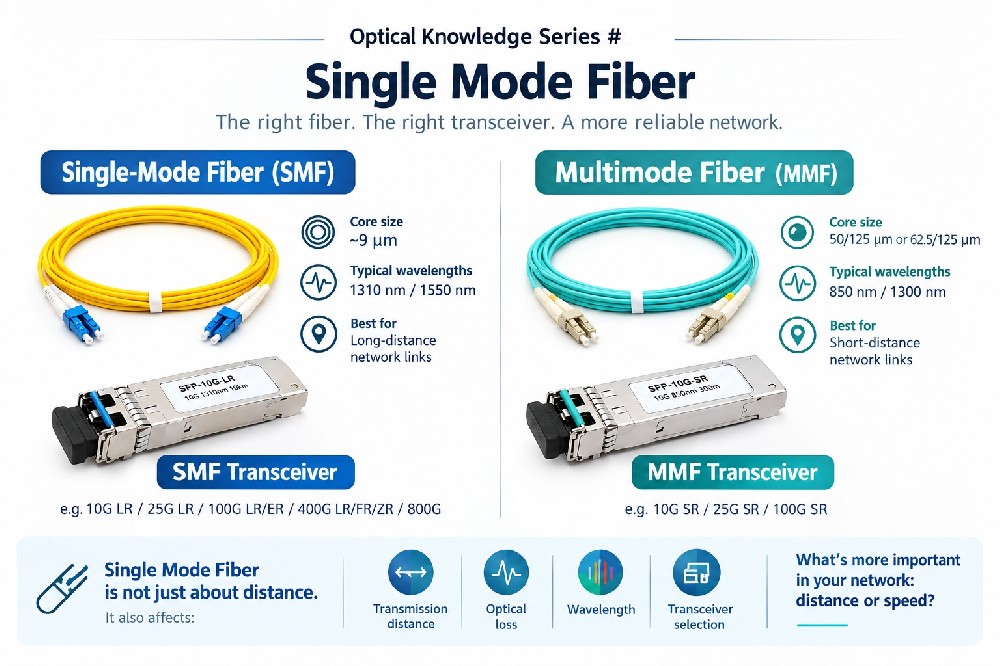
They are commonly used in single-mode fiber (SMF) applications where longer-distance connections are required.
SFP LR — Long Reach for Standard Long-Distance Links
Typical distance: up to 10km
LR modules are one of the most widely used long-distance SFP solutions.
They are commonly deployed in:
Enterprise campus networks
Data center interconnections
Metro access networks
Building-to-building fiber links
For most 10km single-mode fiber connections, LR is usually the first choice because it provides a good balance between performance and cost.
SFP ER — Extended Reach for Longer Fiber Links
Typical distance: up to 40km
ER modules are designed for networks that exceed LR limitations.
Common applications include:
ISP backbone connections
Metropolitan area networks
Long-distance enterprise networks
When a fiber link is longer than approximately 10km, upgrading from LR to ER can provide additional optical power budget without introducing a more complex system.
SFP ZR — Maximum Reach Without DWDM Complexity
Typical distance: up to 80km
ZR modules are used when longer transmission distances are required.
They are often considered for:
Metro network expansion
Long-haul fiber connections
Data center interconnect (DCI)
Compared with building a DWDM system, ZR optics can be a simpler option for point-to-point connections where additional capacity or wavelength management is not required.
How to Choose the Right SFP: A Simple Decision Process
Instead of choosing based only on distance, consider these three questions:
1. How Long Is Your Fiber Link?
A simple guideline:
Under 10km → LR is usually enough
10–40km → Consider ER
40–80km → ZR may be suitable
Always confirm the actual fiber distance, not just the estimated cable length.
2. Do You Need Extra Optical Budget?
Two networks with the same distance may require different modules.
Factors affecting optical performance include:
Fiber quality
Connector loss
Splice points
Patch panels
Environmental conditions
A link close to the maximum distance may require a higher-power module.
3. Are You Planning Future Expansion?
A lower-cost module may work today but limit future upgrades.
For growing networks:
LR provides cost efficiency
ER provides additional margin
ZR provides longer reach flexibility
The right choice depends on your current needs and future plans.
Avoid Overpaying for Optical Modules
A common mistake is selecting a higher-distance module “just to be safe.”
For example:
Using an 80km ZR module for a 5km link may increase cost without providing practical benefits.
A better approach is:
Choose the lowest-cost module that safely meets your link requirements.
Final Thoughts
Choosing between LR, ER, and ZR SFP modules does not need to be complicated.
The key is understanding:
✔ Fiber distance
✔ Optical power budget
✔ Network architecture
✔ Future scalability
With the right optical transceiver selection, you can build a reliable fiber network while avoiding unnecessary investment.
Need help selecting the right SFP LR, ER, or ZR module for your network?
Our technical team can help you check compatibility, distance requirements, and suitable solutions.
Visit: www.sateoptics.com
Previous:Fiber Shortage? How DWDM SFP + MUX/DEMUX Help Engineers Multiply Fiber Capacity by 8×
Next:DAC vs AOC vs Fiber + Optics Buying Guide | How to Choose the Right Data Center Connectivity