
Optical Transceiver Selection Guide: How to Choose the Right Module | Sate Optics
2026-08-14 11:54:29
Why Are There So Many Types of Optical Modules?
A Practical Guide to Choosing the Right Optical Transceiver
If you have ever searched for an optical transceiver, you may have noticed that there are far more options than expected.
SFP, SFP+, SFP28, QSFP+, QSFP28, QSFP-DD, OSFP…
Then come SR, LR, ER, ZR, FR, DR, BiDi, CWDM, DWDM, and many other specifications.
So why are there so many types of optical modules?
The simple answer is that different network applications require different combinations of speed, transmission distance, fiber type, connector, wavelength, and equipment compatibility.
For network engineers, IT teams, system integrators, and procurement teams, understanding these key factors makes optical transceiver selection much easier.
Instead of memorizing hundreds of part numbers, start with five questions:
Speed → Distance → Fiber → Connector → Wavelength
Then verify one more critical factor:
Compatibility.
Why Are There So Many Optical Transceiver Types?
An optical module is not simply a device that “converts electrical signals into optical signals.”
Its specifications are designed around the requirements of a particular network link.
For example, a 10G link inside a data center may only need a short-distance multimode solution, while a 10G telecom link may require single-mode fiber and transmission over tens of kilometers.
Likewise, a 100G connection between switches in a data center may use a different optical module from a 100G connection between buildings or across a metro network.
This is why two optical transceivers can have the same data rate but completely different specifications and applications.
1. Start With Network Speed
The first step is to determine the required data rate.
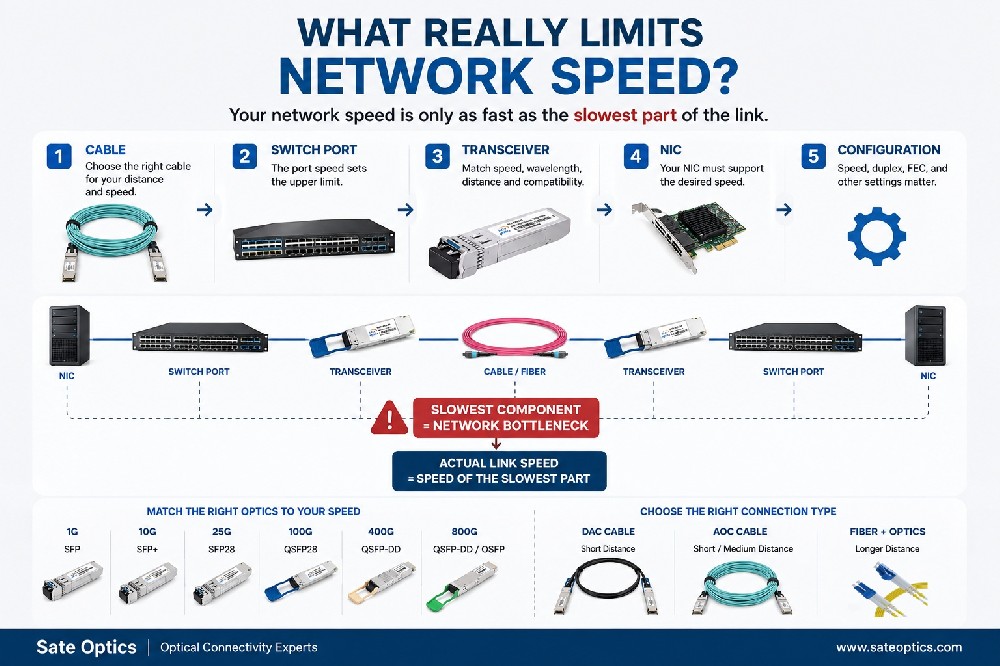
Common optical transceiver speeds include:
| Network Speed | Common Form Factors |
|---|---|
| 1G | SFP |
| 10G | SFP+ |
| 25G | SFP28 |
| 40G | QSFP+ |
| 100G | QSFP28 |
| 200G | QSFP56 / QSFP-DD |
| 400G | QSFP-DD / OSFP |
| 800G | OSFP / QSFP-DD |
The form factor is closely related to the host equipment and port design.
For example, a 10G SFP+ optical transceiver cannot simply be replaced with a 100G QSFP28 module because the physical interface, electrical interface, and network requirements are different.
Common Model Keywords
When searching for compatible optical modules, buyers may encounter keywords such as:
SFP-1G-SX
SFP-1G-LX
SFP-10G-SR
SFP-10G-LR
SFP-25G-SR
SFP-25G-LR
QSFP-40G-SR4
QSFP-100G-SR4
QSFP-100G-LR4
QSFP-100G-ER4
QSFP-DD-400G
OSFP-800G
The exact model should always be matched with the equipment manufacturer, port type, and application.
2. How Far Does the Optical Link Need to Go?
Distance is one of the biggest reasons there are so many optical module types.
A simplified classification is:
Short distance → SR
Medium distance → FR / DR / LR
Longer distance → ER / ZR
However, these labels should not be treated as universal distance rules for every generation of optical technology.
The actual transmission distance depends on factors including:
Optical module specification
Fiber type
Wavelength
Optical power
Receiver sensitivity
Insertion loss
Connector loss
Link budget
Network environment
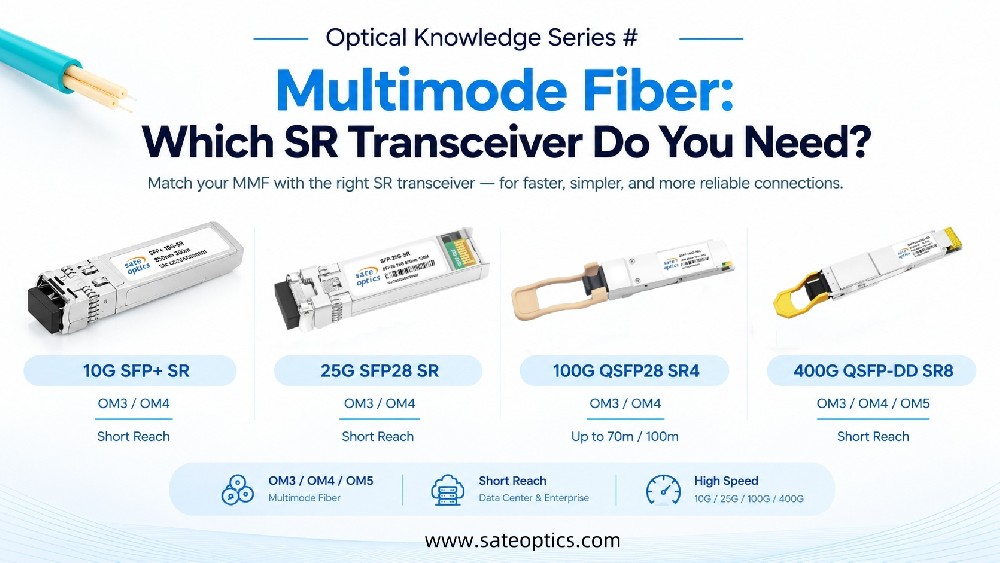
For example, a 100G SR4 module is generally intended for short-distance multimode fiber connections, while 100G LR4 is designed for significantly longer single-mode fiber links.
Therefore, choosing an optical module only by the advertised distance can lead to the wrong purchase.
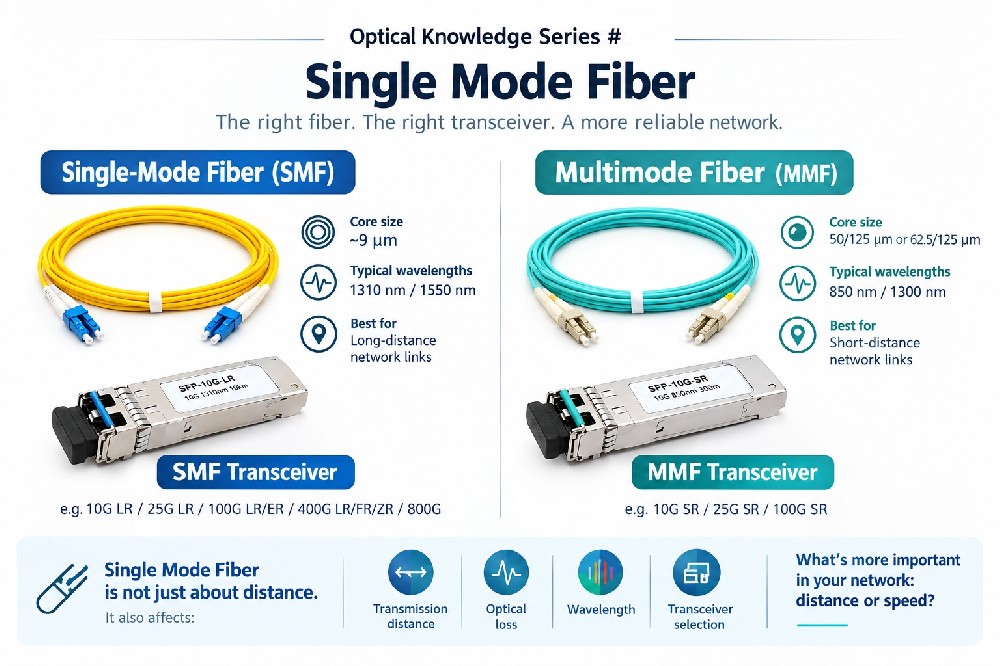
3. MMF or SMF?
The fiber type is another major selection factor.
Multimode Fiber (MMF)
Multimode fiber is commonly used for short-distance applications, especially inside data centers and enterprise networks.
Typical applications include:
Server-to-switch connections
Switch-to-switch connections
Data center rack connections
Short campus links
Many short-distance SR optical modules are designed for multimode fiber.
For example:
100G SR4 + MPO/MTP multimode fiber
is a common architecture for high-speed short-distance connections.
Single-Mode Fiber (SMF)
Single-mode fiber is widely used when longer transmission distances are required.
Typical applications include:
Data center interconnection
Campus networks
Metro networks
Telecom networks
ISP infrastructure
Long-distance backbone connections
Many LR, ER, ZR and WDM optical solutions use single-mode fiber.
Important Procurement Tip
Before selecting the module, check the fiber infrastructure already installed at both ends.
Buying the correct speed but the wrong fiber type can make the solution unusable.
4. Don't Forget the Connector
The connector is another specification that can completely change the required cabling solution.
Common optical connectors include:
LC
SC
MPO/MTP
For example, many duplex optical transceivers use LC connectors, while parallel-optics solutions such as certain 40G and 100G SR modules use MPO/MTP connectors.
This means that selecting:
“100G optical transceiver”
is not enough.
You should also determine:
Which connector does the existing fiber infrastructure use?
This is especially important when upgrading an existing data center.
5. Why Is Wavelength So Important?
Wavelength determines how optical signals are transmitted through the fiber.
Common wavelengths include:
850nm
Often associated with short-distance multimode applications such as SR optics.
1310nm
Commonly used in many single-mode optical transmission applications.
1550nm
Widely used in longer-distance and WDM-related applications.
But wavelength becomes even more important when using:
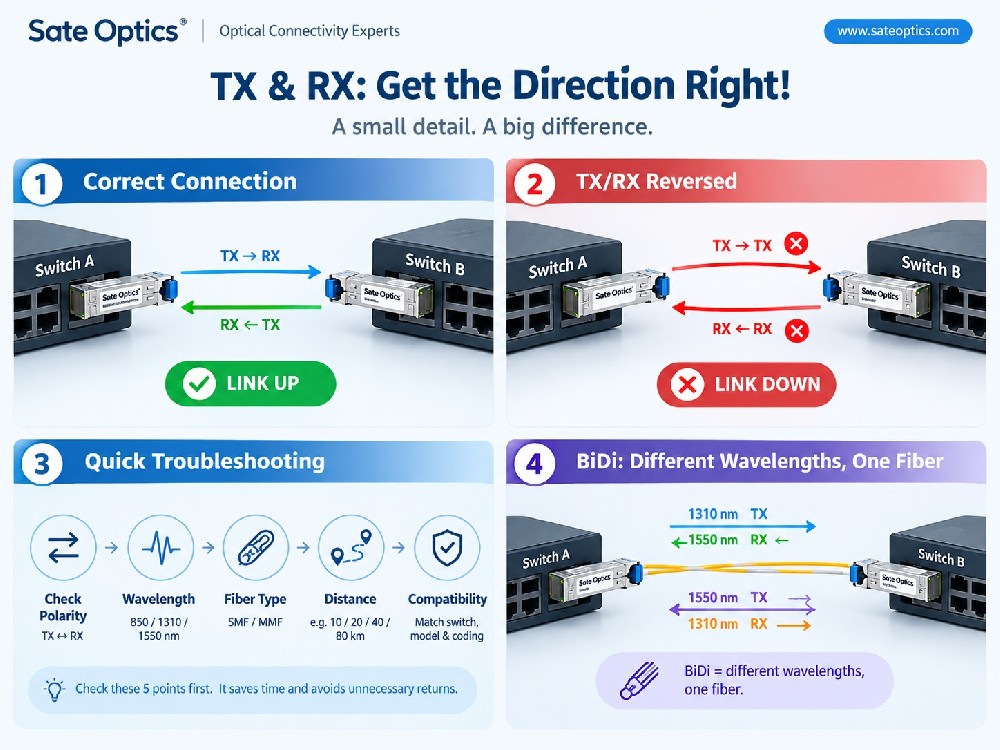
BiDi Optical Transceivers
BiDi modules use different wavelengths for transmission and reception over a single fiber.
For example, one module may transmit at one wavelength and receive at another, while the module at the opposite end uses the corresponding reverse wavelength.
Therefore:
BiDi modules must be used with the correct wavelength pair.
A wrong pairing can prevent the optical link from coming up.
6. CWDM and DWDM: Why Are There So Many Wavelengths?
When network operators need to carry multiple optical channels over the same fiber infrastructure, WDM technologies become useful.
CWDM
Coarse Wavelength Division Multiplexing uses multiple wavelengths to transmit separate optical channels over a single fiber pair.
It is often considered for:
Campus networks
Metro networks
Enterprise networks
Telecom access networks
Network expansion where additional fiber is limited
DWDM
Dense Wavelength Division Multiplexing provides much higher wavelength density.
Typical applications include:
Telecom backbone networks
Metro networks
Data center interconnection
Long-haul optical networks
High-capacity transmission systems
For these applications, the wavelength is not just a specification on the product page.
It is a key part of the network architecture.
7. The Most Important Step: Check Compatibility
Even if the optical specifications look correct, there is one question you should never skip:
Will this module work with my equipment?
Optical transceiver compatibility may involve:
Switch or router model
Port type
Supported data rate
Form factor
Module coding
Firmware considerations
Optical specifications
Vendor compatibility
For example, a buyer may need a Cisco-compatible 10G SFP+ LR, an HPE-compatible 25G SFP28, or a Juniper-compatible 100G QSFP28 LR4.
The optical specification alone is not enough.
For compatible optics, the module must also be correctly coded for the target equipment.
A Simple Optical Module Selection Guide
When selecting an optical transceiver, use this sequence:
Step 1 — Determine the Speed
1G / 10G / 25G / 40G / 100G / 200G / 400G / 800G
↓
Step 2 — Determine the Distance
Short / Medium / Long
↓
Step 3 — Check Fiber
MMF or SMF
↓
Step 4 — Check Connector
LC / SC / MPO/MTP
↓
Step 5 — Check Wavelength
850nm / 1310nm / 1550nm / CWDM / DWDM / BiDi pair
↓
Step 6 — Check Equipment Compatibility
Switch / Router / NIC / Server / OLT / Other network equipment
This simple process can eliminate a large number of unsuitable models before you even request a quotation.
Common Optical Transceiver Applications
Different optical modules are designed for different network environments.
1. Data Centers
Data centers commonly use:
10G SFP+
25G SFP28
40G QSFP+
100G QSFP28
200G QSFP56 / QSFP-DD
400G QSFP-DD / OSFP
800G OSFP
Typical applications include:
Server-to-switch
Switch-to-switch
Leaf-to-spine
Data center interconnect
For short links, DAC and AOC solutions can also be alternatives to optical transceivers and fiber patch cables.
2. Enterprise and Campus Networks
Common applications include:
Building-to-building connections
Distribution-to-access links
Campus backbone
Data center uplinks
Depending on the distance and infrastructure, engineers may choose SFP/SFP+ modules, SFP28, BiDi optics, or WDM solutions.
3. Telecom and ISP Networks
Telecom and ISP environments often require longer transmission distances and more complex optical architectures.
Common solutions include:
Long-distance SFP/SFP+ optics
BiDi optical transceivers
CWDM
DWDM
High-power long-distance optics
The selection process must consider not only distance but also wavelength planning and optical link budget.
4. FTTH and Access Networks
Optical transceivers are also used in access networks involving:
OLT
ONU/ONT
ISP infrastructure
Fiber access networks
In these applications, wavelength, transmission distance, connector type, and equipment compatibility are particularly important.
Common Optical Module Model Keywords
If you are researching optical transceivers online, you may come across these common model keywords:
10G
10G SFP+ SR
10G SFP+ LR
10G SFP+ ER
10G SFP+ ZR
10G BiDi SFP+
25G
25G SFP28 SR
25G SFP28 LR
25G SFP28 ER
40G
40G QSFP+ SR4
40G QSFP+ LR4
40G QSFP+ ER4
100G
100G QSFP28 SR4
100G QSFP28 LR4
100G QSFP28 ER4
100G QSFP28 ZR4
100G CWDM4
100G DR
400G
400G QSFP-DD SR8
400G QSFP-DD DR4
400G QSFP-DD FR4
400G OSFP
800G
800G OSFP SR8
800G QSFP-DD
800G optical transceiver
These keywords are useful when comparing products, but the final selection should always be based on the complete network requirements rather than the model name alone.
5 Common Optical Module Purchasing Mistakes
Mistake 1: Choosing Only by Speed
“100G” does not tell you whether you need SR4, LR4, ER4, DR, FR, CWDM4 or another solution.
Mistake 2: Ignoring Fiber Type
A module designed for multimode fiber should not simply be treated as interchangeable with a single-mode solution.
Mistake 3: Forgetting the Connector
LC and MPO/MTP are not interchangeable without the appropriate cabling architecture.
Mistake 4: Ignoring Wavelength
This is especially risky for BiDi, CWDM and DWDM systems.
Mistake 5: Checking Compatibility Too Late
Compatibility should be confirmed before purchasing, not after the module arrives.
FAQ: Optical Transceiver Selection
What is the difference between SFP, SFP+, and SFP28?
They are different optical transceiver form factors designed for different network speeds. SFP is commonly associated with 1G, SFP+ with 10G, and SFP28 with 25G applications.
How do I choose between SR and LR?
Start with the required transmission distance and fiber type. SR is generally used for shorter links, often over multimode fiber, while LR is commonly used for longer single-mode fiber links.
Can I use a 100G module for any 100G connection?
No. Different 100G modules can have different transmission distances, fiber requirements, connectors, wavelengths, and optical architectures.
What is the difference between BiDi and standard optical transceivers?
A standard duplex optical link commonly uses separate fibers for transmit and receive. BiDi technology can transmit and receive using different wavelengths over a single fiber, requiring a correctly matched pair.
Are compatible optical transceivers safe to use?
Compatible optics are designed to work with specified OEM equipment when the correct compatibility, coding, optical specifications, and application requirements are confirmed. Always verify the target device model before ordering.
What information should I provide when requesting an optical transceiver quotation?
Ideally provide:
Switch/router/OLT model
Port type
Required speed
Transmission distance
Fiber type
Connector
Wavelength, if applicable
Required quantity
OEM compatibility requirement
This allows the supplier to recommend a more accurate solution.
Choose the Right Optical Transceiver With Sate Optics
With hundreds of optical transceiver specifications available, choosing the right model does not have to be complicated.
At Sate Optics, we support optical connectivity solutions from 1G to 800G, including:
SFP
SFP+
SFP28
QSFP+
QSFP28
QSFP56
QSFP-DD
OSFP
BiDi optical transceivers
CWDM / DWDM solutions
DAC cables
AOC cables
MPO fiber connectivity
Our compatible optical transceivers are available for a range of major networking platforms and can be supplied for data center, telecom, ISP, enterprise, campus, and other networking applications.
Need help selecting the right model?
Send us your equipment model + speed + distance + fiber type, and our team can help narrow down the suitable optical transceiver options.
Don't start with the model number.
Start with:
Speed → Distance → Fiber → Connector → Wavelength → Compatibility
That's the easiest way to find the right optical module for your network.
Sate Optics | Optical Connectivity Experts
Previous:Data Center Copper vs Fiber: RJ45, DAC, AOC & Optical Transceivers
Next:Auto-Negotiation: Why Two Devices Sometimes Refuse to Connect