
100G QSFP28 for Spine-Leaf Networks: Choosing SR4, CWDM4, LR4, DAC and AOC by Link Tier
2026-11-10 09:21:38
A spine-leaf fabric looks simple on a whiteboard: every leaf connects to every spine, and traffic crosses at most two hops. The cabling is where projects quietly overspend — or underbuild. Teams either buy long-reach optics for every port "to be safe" and waste budget on links that run three meters, or they stretch short-reach parts across a hall and discover the loss budget on installation day.
The fix is to choose the link type tier by tier. A 100G spine-leaf fabric has three distinct link tiers, each with its own distance, media and cost profile. This guide walks through each tier with the 100G QSFP28 transceivers, DAC and AOC options that fit it, using the same specifications you will find in the product tables.
The Three Link Tiers in a 100G Spine-Leaf Fabric
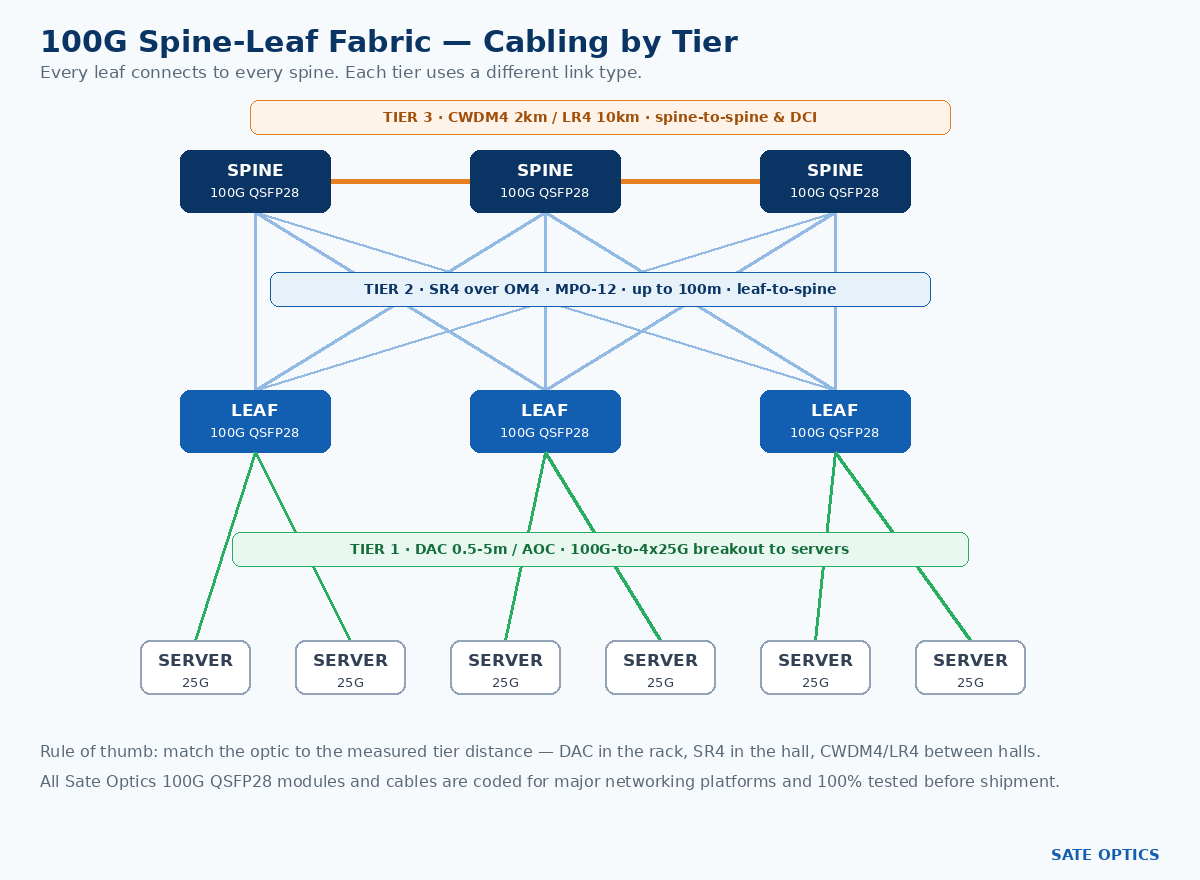
A 100G spine-leaf fabric cabled by tier — each tier uses a different link type.
Tier 1 — Inside the rack (up to about 5m). Server-to-leaf and leaf-to-leaf links inside one rack or between adjacent racks. Distances are measured in meters, port counts are high, and per-link cost dominates.
Tier 2 — Leaf to spine inside one hall (up to 100m). The classic fabric links. They run over structured cabling, usually multimode fiber with MPO trunks pre-installed between rows.
Tier 3 — Spine to spine, hall to hall, building to building (100m to 10km). Fewer links, longer distances, almost always single-mode fiber. This is also the tier that later grows into data center interconnect (DCI).
Most selection mistakes come from applying one tier's answer to another tier. The sections below treat each tier separately.
Tier 1: DAC First, AOC When the Rack Fights Back
Inside a rack, a passive DAC is the simplest 100G link that exists: two QSFP28 ends on one twinax copper cable, no optics, no lasers, almost no power draw. Our 100G QSFP28 DAC cables run from 0.5m to 5m in passive builds, which covers server-to-ToR and most rack-to-rack runs. If the distance fits DAC, DAC is almost always the right answer on cost, power and reliability.
Switch to 100G QSFP28 AOC cables (1m to 100m) when copper becomes the problem: very dense racks where thick twinax blocks airflow, runs that need to bend through cable managers, or lengths just past the 5m passive DAC limit. An AOC is a fixed-length optical link with the transceivers built onto the cable ends — plug both ends in and the link is up, with no separate modules or patch cords to match. Measure the real cable path, including vertical runs and slack, before choosing a length; an AOC cannot be extended later.
Breakout lives in this tier. A leaf switch's 100G QSFP28 port can fan out to four 25G SFP28 server links through a 100G-to-4×25G breakout cable (DAC in-rack, AOC up to 60m). This is how one 100G port serves four 25G servers, and it is the standard way to build server leafs in a 100G fabric. Two conditions catch people out: the switch port must support breakout mode (check the switch's port configuration, and tell us your switch model before ordering if you are unsure), and each of the four lanes lands as an independent 25G link, so the four servers must be planned as a group.
Tier 2: SR4 over Multimode Is the Fabric Default
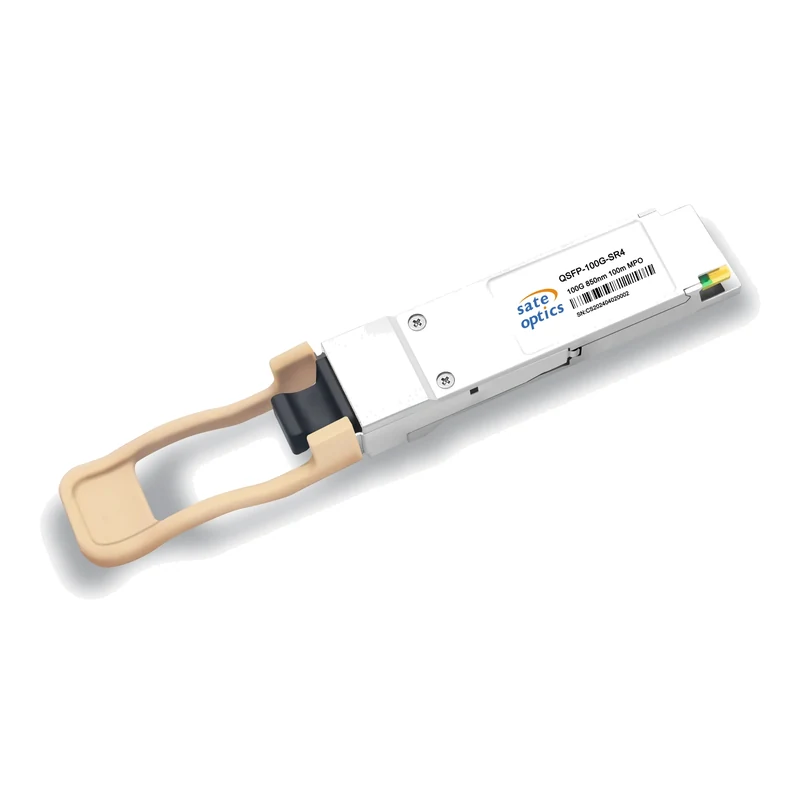
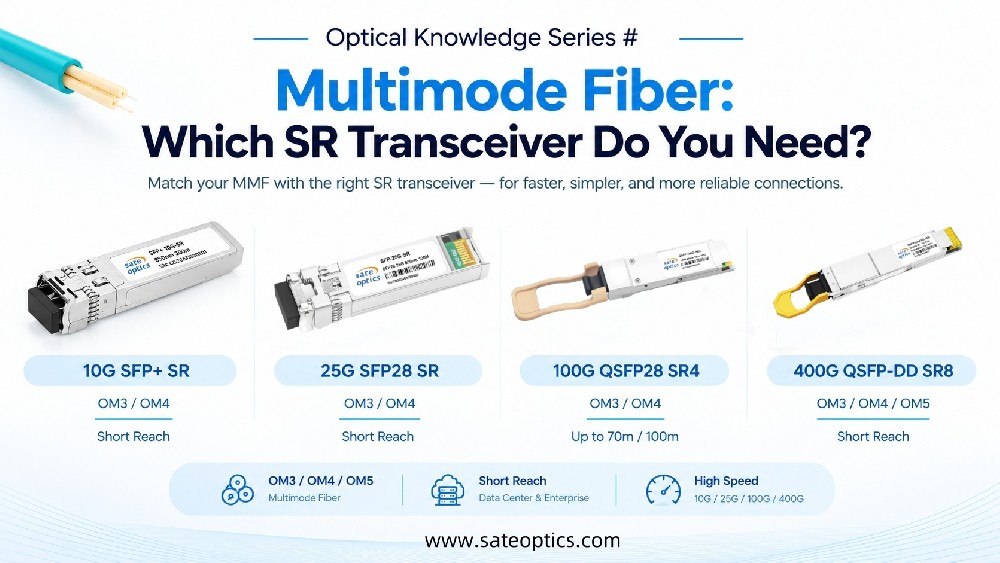
For leaf-to-spine links inside a hall, the QSFP28 SR4 is the default choice when multimode structured cabling is in place. It runs four 25G NRZ lanes at 850nm over an MPO-12 interface, reaching up to 100m on OM4 multimode fiber (budget 70m on OM3 — measure your longest run against the fiber grade you actually have, not the grade on the original plan).
Key figures from the SR4 specification: transmit power −8.4 to +2.4 dBm, receiver sensitivity −10.3 dBm, commercial 0–70°C operating range, with DDM monitoring of optical power, temperature and voltage on every port. That DDM data is what makes a large fabric operable: when a link degrades, you can see which end is drifting before it fails.
Two SR4 details deserve attention at install time. First, MPO polarity: parallel multimode links need consistent polarity end to end (Type B is the common choice for direct SR4 links); a reversed trunk shows up as a link that simply never comes up. Second, SR4 breaks out cleanly to 4×25G multimode endpoints, so the same optic serves both leaf-spine duty and, where needed, direct 25G aggregation.
Tier 3: CWDM4 to 2km, LR4 to 10km, on Duplex Single-Mode
When spine links leave the hall — to a second hall, a campus building, or a meet-me room — the fabric moves to single-mode fiber and duplex LC connectors, and the choice narrows to two optics:
CWDM4 (2km) carries four 25G lanes on CWDM wavelengths (1271–1331nm) over one duplex LC pair, with −6.5 to +2.5 dBm transmit power and −10 dBm receiver sensitivity. It costs less than LR4 because it does not need LR4's tighter LAN-WDM optics, so for any single-mode run up to 2km it is the economical default.
LR4 (10km) is the universal 10km reach: four LAN-WDM lanes around 1310nm over duplex LC, −4.3 to +4.5 dBm transmit power and −10.6 dBm receiver sensitivity. It is the standard budget for DCI handoffs, metro aggregation and carrier Ethernet, and the safe choice when a link may later be re-patched to a longer path.
A useful rule: if the route is fixed, measured and under 2km, buy CWDM4. If the route may change, crosses carrier or campus infrastructure, or is simply "somewhere under 10km," buy LR4 and keep one optic type across the whole tier. (A parallel single-mode option, PSM4, also covers 2km over MPO-12 and breaks out naturally to 4×25G single-mode endpoints — worth considering only if your plant is already built on parallel single-mode trunks.)
Quick Reference: Link Tier to Link Type
| Link tier | Typical distance | Media | Choose | Connector |
| Server–leaf, in-rack | 0.5–5m | Twinax copper | Passive DAC (or DAC breakout to 4×25G) | QSFP28 direct attach |
| In-rack / row, flexible routing | 1–100m | Fiber (fixed assembly) | AOC (or AOC breakout to 4×25G, up to 60m) | QSFP28 direct attach |
| Leaf–spine, same hall | Up to 70m (OM3) / 100m (OM4) | Multimode fiber | QSFP28 SR4 | MPO-12 |
| Spine–spine / campus | Up to 2km | Single-mode fiber | QSFP28 CWDM4 | Duplex LC |
| Spine–spine / DCI handoff | Up to 10km | Single-mode fiber | QSFP28 LR4 | Duplex LC |
Four Mistakes That Cost More Than the Optics
Specifying LR4 everywhere. On a 48-port leaf, the price gap between SR4 and LR4, multiplied across every port and both ends, routinely exceeds the cost of the multimode cabling that would have made SR4 possible. Match the optic to the measured tier distance.
Forgetting breakout mode. A breakout cable in a port that is configured (or licensed) as a single 100G port delivers zero working 25G links. Confirm breakout support on your exact switch model and firmware before the cables arrive.
Trusting the plan distance instead of the path distance. A "60m" hall link with vertical runs, patch panels and slack is often an 85m link. SR4 on OM3 tops out at 70m — that link belongs on OM4, CWDM4, or single-mode, and the time to find out is before ordering.
Mixing FEC settings across a link. 100G links that rely on RS-FEC need it enabled consistently at both ends; a mismatch presents as a link that trains intermittently and generates errors under load. Set it once, the same way, on both ends.
Before You Order
Every Sate Optics 100G QSFP28 module, DAC and AOC is coded for major networking platforms — including Cisco, Juniper, Arista, Huawei, Nokia, H3C and ZTE — and 100% tested before shipment, and every one is covered by a 3-year warranty with lifetime maintenance. Standard lead time is 3–7 days for most products, and samples are available for evaluation.
If you are cabling a fabric, send us the switch models and the longest run in each tier. We will confirm compatibility and the tier-by-tier selection before you order — it is much cheaper than returning the wrong reach.
Need Help Choosing the Right Module?
Tell us your switch model and the distance you need to cover — we confirm compatibility and reply within 24 hours.
Get a Quote Chat on WhatsAppPrevious:OFC 2026: The Industry Moves Toward 1.6T Optical Connectivity
Next:No More