
A Simple Guide to Fiber and Ethernet Connectors Used in SFP, SFP+, QSFP28 and 400G Optical Modules
2026-05-28 15:27:53
🔥 A Simple Guide to LC, SC, MPO and RJ45 Connectors in SFPs
Choosing the wrong connector can lead to:
❌ Compatibility issues
❌ Cable confusion
❌ Higher deployment costs
❌ Difficult upgrades later
But many beginners still ask:
👉 What’s the difference between LC, SC, MPO and RJ45?
👉 Why do some optical modules use duplex fiber while others use ribbon fiber?
👉 When should you use RJ45 instead of fiber optics?
Here’s the simple explanation 👇
1️⃣ LC Connector — The Most Common in Modern SFPs
LC = Small Form Factor Connector
You’ll see LC on:
✅ SFP
✅ SFP+
✅ SFP28
✅ QSFP modules (SR4/DR4 breakout)
✅ Most 1G/10G/25G fiber links
Why it became popular:
✔ Small size
✔ High density
✔ Perfect for switches and data centers
✔ Easy duplex Tx/Rx connection
Typical use cases:
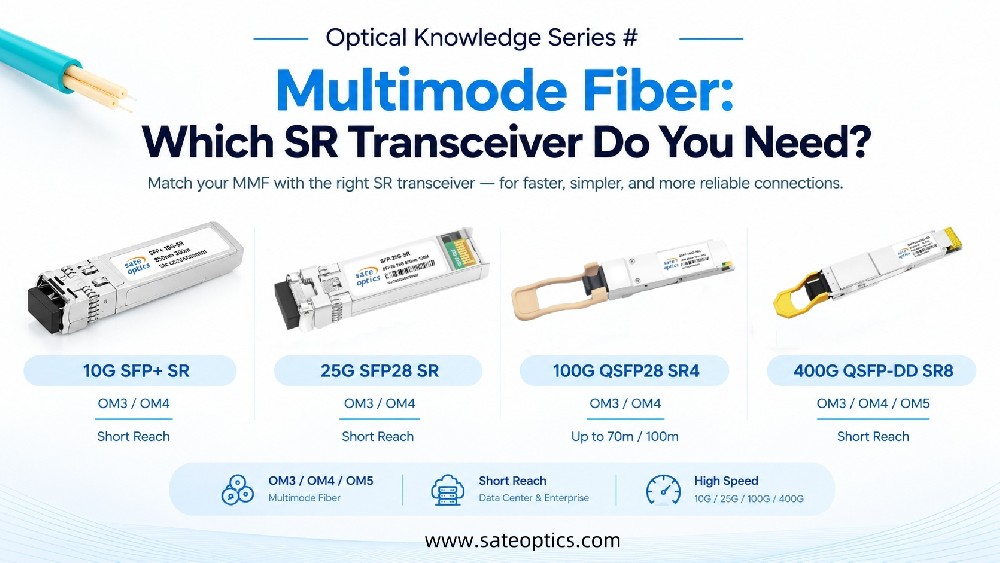
• 10G SFP+ SR
• 25G SFP28 LR
• CWDM/DWDM optics
• BiDi modules
If you work with modern switches, LC is probably everywhere.
2️⃣ SC Connector — Older but Still Used
SC = Subscriber Connector
Compared with LC:
• Larger size
• Push-pull design
• Easier to handle manually
• Lower port density
Still commonly found in:
✅ Telecom rooms
✅ Older fiber equipment
✅ Media converters
✅ GPON/EPON devices
SC was extremely popular before LC became dominant.
Today:
LC dominates data centers,
while SC still appears in telecom and legacy networks.
3️⃣ MPO Connector — Built for High-Speed Parallel Optics
MPO = Multi-Fiber Push-On
This is completely different from LC/SC.
Instead of:
1 fiber pair (Tx/Rx)
MPO contains:
✅ 8 fibers
✅ 12 fibers
✅ 16 fibers
inside ONE connector.
Why?
Because 40G/100G/400G networks often use:
parallel optical transmission.
Common examples:
• 40G QSFP+ SR4
• 100G QSFP28 SR4
• 400G QSFP-DD SR8
Why hyperscale data centers love MPO:
✔ Extremely high density
✔ Easier cable management
✔ Supports massive bandwidth upgrades
But:
❗ MPO cleaning and polarity matter a lot
❗ Installation is more complex than LC
4️⃣ RJ45 — Copper Ethernet Instead of Fiber
RJ45 is NOT fiber.
It uses:
copper Ethernet cables (Cat5e/Cat6/Cat6a).
Common in:
✅ Offices
✅ Enterprise networks
✅ Short-distance links
Typical modules:
• 1G RJ45 SFP
• 10G RJ45 SFP+
Advantages:
✔ Easy deployment
✔ Existing copper cabling
✔ Lower initial cost
Disadvantages:
❌ Higher power consumption
❌ More heat
❌ Shorter distance at high speed
❌ Usually higher latency than fiber
This is why:
10G RJ45 SFP+ modules often run hotter than optical modules.
Quick Summary 👇
✅ LC → Modern fiber standard for most SFPs
✅ SC → Older/larger telecom connector
✅ MPO → High-density connector for 40G/100G/400G
✅ RJ45 → Copper Ethernet connection
As network speeds move from:
10G → 25G → 100G → 400G → 800G,
connector selection becomes more important than many people realize.
Especially for:
• Data center upgrades
• AI clusters
• Hyperscale networks
• Structured cabling planning
Understanding connectors early can save a lot of trouble later.
#Networking #SFP #FiberOptics #DataCenter #Ethernet #MPO #RJ45 #OpticalTransceiver #QSFP28 #400G #800G #ITInfrastructure
Previous:Fiber Optic Cable Types for SFPs Explained Simply | SMF vs MMF, OM1-OM5 Guide
Next:DAC vs AOC vs Optical Transceivers: What's the Difference?