
DAC vs AOC vs Optical Transceivers: What's the Difference?
2026-06-02 17:10:55
Understanding the Three Most Common Data Center Connectivity Options
In modern data centers and enterprise networks, DACs, AOCs, and optical transceivers are among the most widely used connectivity solutions.
All three are designed to connect switches, servers, storage systems, and network equipment. They can support data rates ranging from 10G and 25G to 100G, 400G, and even 800G.
However, many IT professionals, network engineers, and procurement teams still wonder:
What is the difference between DAC, AOC, and optical transceivers?
Which option is best for a specific application?
How do cost, distance, and flexibility compare?
This guide explains the key differences and helps you choose the right solution for your network.
What Is a DAC (Direct Attach Cable)?
A Direct Attach Cable (DAC) is a high-speed copper cable with transceiver connectors permanently attached to both ends.
Unlike optical solutions, DACs use copper conductors to transmit data directly between devices.
Because the cable and connectors are integrated into a single assembly, deployment is simple—just plug the cable into the network ports and it is ready to use.
Advantages of DAC Cables
Lowest acquisition cost
Lowest power consumption
Very low latency
Plug-and-play installation
No fiber management required
Limitations of DAC Cables
Limited transmission distance
Heavier and less flexible than fiber cables
Not suitable for long-distance applications
Typical DAC Applications
DACs are commonly used for:
Top-of-Rack (ToR) switching
Server-to-switch connections
In-rack connectivity
Short rack-to-rack links
Typical transmission distances range from 1 to 7 meters, although some passive and active DAC solutions can support longer distances.
What Is an AOC (Active Optical Cable)?
An Active Optical Cable (AOC) combines optical transceivers and fiber optic cable into a single integrated assembly.
Unlike DACs, AOCs use optical fiber rather than copper to transmit data.
The optical modules are permanently attached to the cable, meaning the fiber cannot be removed or replaced separately.
This design offers the simplicity of a DAC while providing the performance advantages of optical fiber.
Advantages of AOCs
Lightweight design
Longer transmission distances than DACs
Easy plug-and-play deployment
Reduced cable management complexity
Immune to electromagnetic interference (EMI)
Limitations of AOCs
Fixed cable length
Entire assembly must be replaced if damaged
Less flexible than modular optical solutions
Typical AOC Applications
AOCs are commonly deployed for:
Data center interconnects
High-density server environments
Storage networking
Medium-distance switch-to-switch connections
Typical transmission distances range from 10 meters to 100 meters depending on the data rate and application.
What Is an Optical Transceiver?
An optical transceiver is a separate network module installed into a switch, router, server, or storage device.
Unlike DACs and AOCs, the optical transceiver and fiber optic cable are separate components.
A complete optical link consists of:
Switch → Optical Transceiver → Fiber Cable → Optical Transceiver → Switch
This modular architecture provides maximum flexibility and scalability.
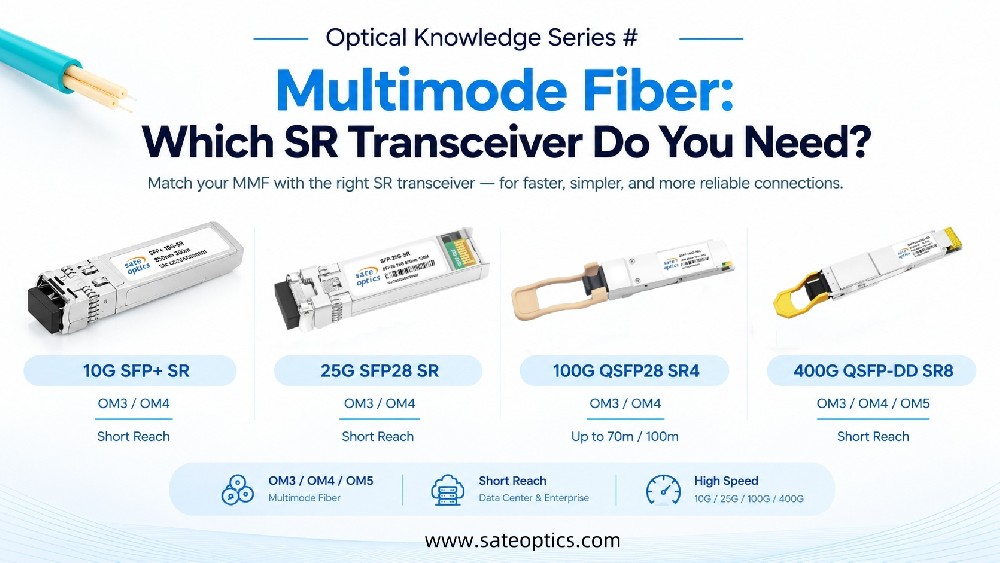
Common optical transceiver form factors include:
Advantages of Optical Transceivers
Fiber and module can be replaced separately
Supports a wide range of transmission distances
Easy network upgrades
Flexible deployment options
Ideal for long-term network scalability
Limitations of Optical Transceivers
Higher initial cost
Requires separate fiber patch cables
More planning and component selection required
Typical Optical Transceiver Applications
Optical transceivers are widely used in:
Enterprise networks
Campus networks
Telecommunications infrastructure
Data center interconnects
Metro and long-haul networks
Depending on the optical technology used, transmission distances can range from a few meters to more than 80 kilometers.
DAC vs AOC vs Optical Transceiver Comparison
| Feature | DAC | AOC | Optical Transceiver |
|---|---|---|---|
| Transmission Medium | Copper | Fiber | Fiber |
| Distance | Short | Medium | Short to Long |
| Cost | Lowest | Moderate | Higher |
| Power Consumption | Lowest | Low | Moderate |
| Flexibility | Low | Low | High |
| Maintenance | Replace Entire Cable | Replace Entire Cable | Replace Components Separately |
| Upgrade Capability | Limited | Limited | Excellent |
| Typical Reach | 1-7m | 10-100m | Up to 80km+ |
Which Solution Should You Choose?
Choose DAC If:
Distance is less than 7 meters
Lowest cost is the primary goal
Connections are inside the same rack
Power efficiency is important
Choose AOC If:
Longer distances than DAC are required
Easy deployment is preferred
Lightweight cabling is beneficial
Typical reach is between 10 and 100 meters
Choose Optical Transceivers If:
Network scalability is important
Long-distance connectivity is required
Components may need replacement independently
Future upgrades are expected
Enterprise or telecom environments are involved
Why Optical Transceivers Remain Popular in Enterprise Networks
Although DACs and AOCs offer excellent simplicity, many organizations continue to choose optical transceivers because network requirements evolve over time.
For example:
A 30-meter connection today may become a 100-meter connection tomorrow.
A damaged fiber cable can be replaced without changing the optics.
Network upgrades can often be completed by replacing only the transceivers.
This flexibility can significantly reduce long-term operating costs and simplify future network expansion.
SATE Compatible DAC, AOC and Optical Transceiver Solutions
SATE provides a comprehensive portfolio of compatible networking solutions for data centers, enterprise networks, cloud infrastructure, and telecom applications.
Our product range includes:
All products are tested for compatibility, reliability, and high-performance operation across major networking platforms.
Conclusion
DACs, AOCs, and optical transceivers all play important roles in modern network infrastructure.
The best choice depends on your specific requirements:
DAC = Lowest Cost
AOC = Simple Optical Connectivity
Optical Transceiver = Maximum Flexibility
By understanding the strengths and limitations of each technology, organizations can build cost-effective, scalable, and high-performance networks that meet both current and future demands.
Previous:A Simple Guide to Fiber and Ethernet Connectors Used in SFP, SFP+, QSFP28 and 400G Optical Modules
Next:Single-Fiber vs Dual-Fiber Optics: Which is Better for Campus Networks?