
How to Choose the Right Fiber Optic Cable for Your Optical Transceiver: A Complete Guide
2026-07-06 16:24:30
How to Choose the Right Fiber Optic Cable for Your Optical Transceiver
Selecting the right optical transceiver is only half of building a reliable fiber network.
Many network failures that appear to be caused by optical modules are actually the result of using the wrong fiber optic cable, incorrect connectors, or poor-quality patch cords.
Whether you're deploying a data center, upgrading an enterprise network, or expanding an ISP backbone, understanding fiber cable selection can save hours of troubleshooting and prevent unnecessary equipment replacement.
In this guide, we'll explain how fiber optic cables work with optical transceivers and how to choose the right solution for your network.
Why Fiber Optic Cables Matter
An optical communication link consists of more than just the transceiver.
A complete optical link typically includes:
Switch
      │
Optical Transceiver
      │
Fiber Patch Cord
      │
Patch Panel / ODF
      │
Backbone Fiber
      │
Fiber Patch Cord
      │
Optical Transceiver
      │
Server / Router / Switch
If any component in this link is mismatched or of poor quality, the overall network performance may be affected.
Even the best optical module cannot compensate for an unsuitable fiber infrastructure.
Four Key Factors When Choosing Fiber Optic Cables
1. Select the Correct Fiber Type
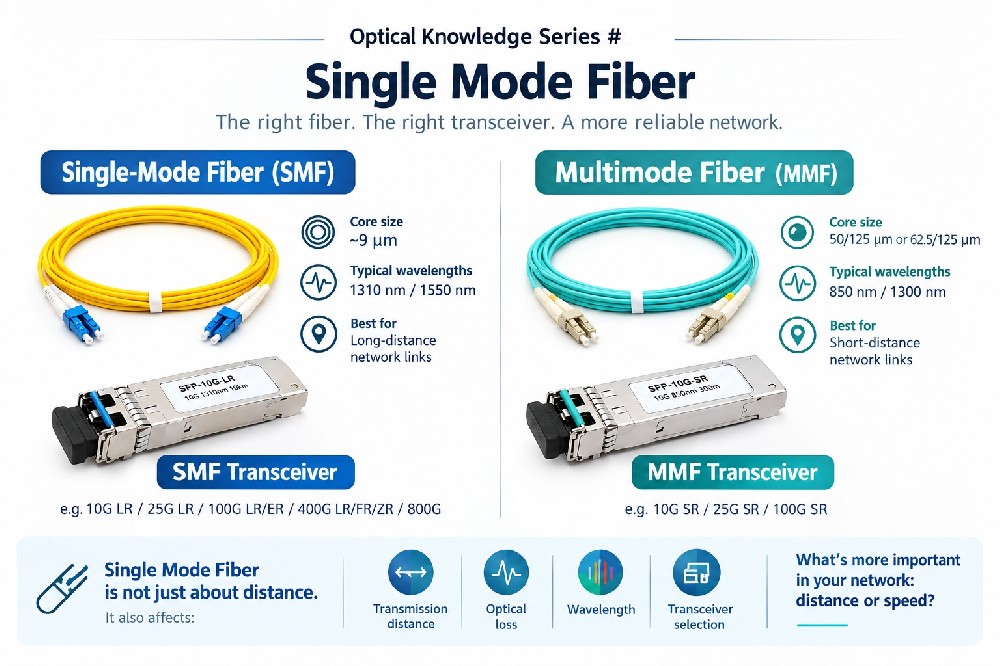
The first step is choosing between single-mode and multimode fiber.
Single-Mode Fiber (OS2)
Recommended for:
Long-distance transmission
Metro networks
Telecom
Campus networks
Data centers with long fiber runs
Compatible with:
1G LX
10G LR
25G LR
40G LR4
100G LR4
400G DR4
400G FR4
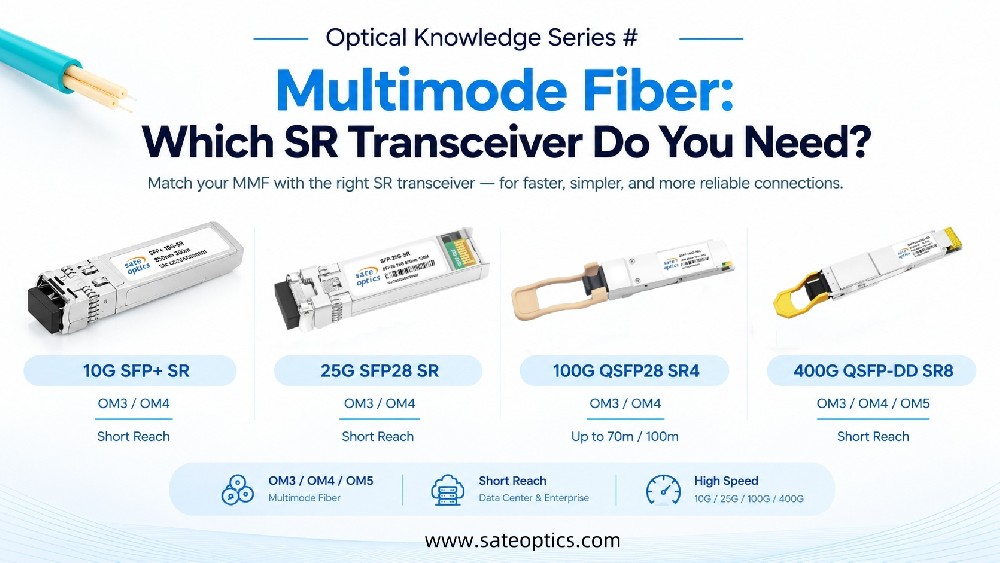
Multimode Fiber (OM3 / OM4 / OM5)
Recommended for:
Short-distance connections
Server rooms
Enterprise LANs
High-density data centers
Compatible with:
10G SR
25G SR
40G SR4
100G SR4
400G SR8
2. Match the Fiber to the Transmission Distance
Distance is one of the most important considerations.
For example:
| Optical Module | Recommended Fiber | Typical Distance |
|---|---|---|
| 10G SR | OM3 / OM4 | Up to 300–400 m |
| 10G LR | OS2 | 10 km |
| 25G SR | OM4 | Up to 100 m |
| 100G SR4 | OM4 MPO | Up to 100 m |
| 100G LR4 | OS2 | 10 km |
| 400G DR4 | OS2 MPO | 500 m |
| 400G FR4 | OS2 LC | 2 km |
Using a cable outside its supported distance may lead to unstable links, packet loss, or reduced performance.
3. Ensure Connector Compatibility
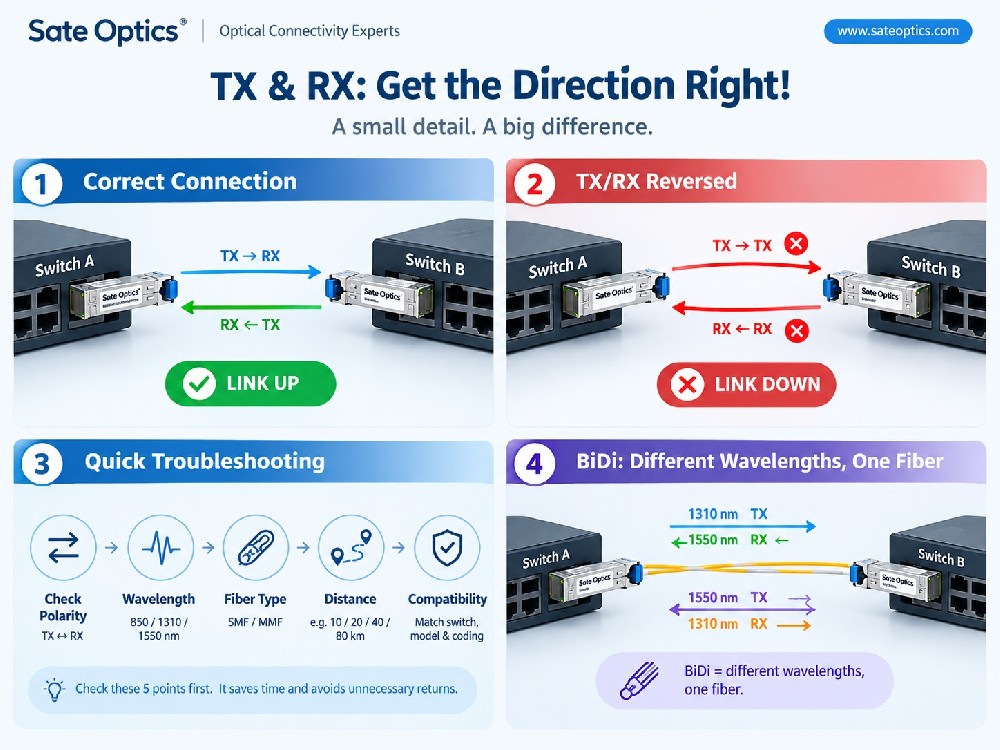
Connector mismatches are another common cause of deployment issues.
Common connector types include:
LC Duplex
SC
MPO/MTP
UPC
APC
Before installation, verify that both the optical module and fiber cable use compatible connectors and polishing types.
4. Don't Ignore Cable Quality
Not all fiber patch cords are manufactured to the same standard.
High-quality cables provide:
Lower insertion loss
Better return loss
Improved durability
Higher network reliability
Choosing certified patch cords can significantly reduce maintenance costs over the lifetime of the network.
Common Mistakes to Avoid
Many network issues originate from simple installation errors.
Typical examples include:
❌ Using single-mode transceivers with multimode fiber
❌ Mixing UPC and APC connectors
❌ Using low-quality patch cords
❌ Exceeding the supported transmission distance
❌ Dirty fiber connectors
❌ Excessive cable bending
Avoiding these mistakes helps maximize the performance of your optical infrastructure.
Compatible Optical Transceiver Models
SATE Optics supplies fiber optic cables compatible with a wide range of optical transceivers, including:
1G SFP
Cisco GLC-SX-MMD
Cisco GLC-LH-SMD
Cisco GLC-ZX-SM
10G SFP+
Cisco SFP-10G-SR
Cisco SFP-10G-LR
Cisco SFP-10G-ER
25G SFP28
Cisco SFP-25G-SR-S
Cisco SFP-25G-LR-S
40G QSFP+
Cisco QSFP-40G-SR4
Cisco QSFP-40G-LR4
100G QSFP28
Cisco QSFP-100G-SR4-S
Cisco QSFP-100G-LR4-S
Cisco QSFP-100G-CWDM4-S
400G QSFP-DD
QSFP-DD SR8
QSFP-DD DR4
QSFP-DD FR4
QSFP-DD LR4
Our fiber patch cords are also compatible with modules from Huawei, Juniper, Arista, Dell, HPE, NVIDIA, Fortinet, MikroTik, Ubiquiti, and many other leading networking platforms.
Typical Applications
Our fiber optic cable solutions are widely used in:
Enterprise Networks
Data Centers
AI Computing Clusters
Cloud Infrastructure
Internet Service Providers (ISPs)
Telecom Networks
Campus Networks
Government Projects
Industrial Ethernet
Smart City Infrastructure
Financial Networks
Healthcare Networks
Why Choose SATE Optics?
With more than 20 years of experience in optical networking, SATE Optics provides complete connectivity solutions—not just optical transceivers.
Our product portfolio includes:
1G–800G Optical Transceivers
DAC Cables
AOC Cables
Ethernet Switches
Network Accessories
Fiber Patch Cords
MPO/MTP Cables
Every solution is verified for compatibility, performance, and reliability before delivery.
Frequently Asked Questions (FAQ)
Q1. Can I use a single-mode transceiver with multimode fiber?
No. Single-mode and multimode optical systems are designed for different fiber types. Using the wrong combination may prevent the link from working correctly.
Q2. What is the difference between OM3 and OM4 fiber?
OM4 fiber supports higher bandwidth and longer transmission distances than OM3, making it a better choice for modern 40G and 100G data center deployments.
Q3. Do fiber patch cords affect optical performance?
Yes. Connector quality, insertion loss, return loss, and cable construction all influence network stability and signal integrity.
Q4. Which connector should I choose: LC or MPO?
LC connectors are commonly used with duplex optical modules such as SFP, SFP+, SFP28, and many QSFP-DD FR4 modules. MPO/MTP connectors are typically used for parallel optics such as QSFP+ SR4, QSFP28 SR4, and QSFP-DD SR8.
Q5. Can SATE Optics recommend both transceivers and fiber cables?
Yes. Our technical team can recommend a complete end-to-end connectivity solution based on your transmission distance, switch platform, application, and budget.
Call to Action (CTA)
Planning a new fiber network or upgrading your existing infrastructure?
Whether you need compatible optical transceivers, fiber patch cords, MPO/MTP cabling, DAC, AOC, or complete network connectivity solutions, SATE Optics is ready to help.
Our experienced team can recommend the right combination of transceivers and fiber optic cables for your specific application, ensuring reliable performance, broad compatibility, and cost-effective deployment.
Previous:DAC vs Fiber Cable: Which Is Better for Short-Distance Data Center Connections?
Next:Where Are DAC Cables Used? Applications in Data Centers & AI