
Making the Right Choice Between SFP, SFP+, and QSFP — Save Cost and Avoid Compatibility Issues
2026-06-09 16:32:57
👉 SFP vs SFP+ vs QSFP: What Most Engineers Get Wrong
If you've ever searched:
SFP vs SFP+
QSFP vs SFP difference
Can I use SFP in an SFP+ port?
Which transceiver do I actually need?
You're not alone.
These are some of the most searched questions in networking.
And surprisingly, many networks end up spending more than necessary because the wrong transceiver is chosen from the beginning.
The good news?
Understanding the difference between SFP, SFP+, and QSFP is much easier than it looks.
Why This Confuses So Many People
Many engineers assume:
Bigger module = better network.
But that's not always true.
In real deployments, the goal isn't to buy the fastest transceiver available.
The goal is to match:
✅ Required bandwidth
✅ Transmission distance
✅ Existing switch hardware
✅ Future upgrade plans
Choosing a module that's too small creates bottlenecks.
Choosing one that's too large wastes budget.
Both happen every day.
Understanding the Basics
1️⃣ SFP (1G)
SFP stands for Small Form-factor Pluggable.
Traditionally used for:
1 Gigabit Ethernet
Enterprise access networks
CCTV networks
Industrial Ethernet
Legacy infrastructure
Typical options include:
1000BASE-SX
1000BASE-LX
BiDi SFP
CWDM SFP
Common distances:
550m over multimode fiber
10km to 80km over single-mode fiber
Best For
If your switches only support 1G traffic, upgrading to higher-speed optics won't improve performance.
Many stable enterprise networks still operate successfully with 1G links.
2️⃣ SFP+ (10G)
SFP+ looks almost identical to SFP.
This is where many mistakes begin.
The physical size is nearly the same.
The speed is not.
SFP+ supports:
10 Gigabit Ethernet
Data center aggregation
Enterprise core switching
Campus backbone networks
Popular variants include:
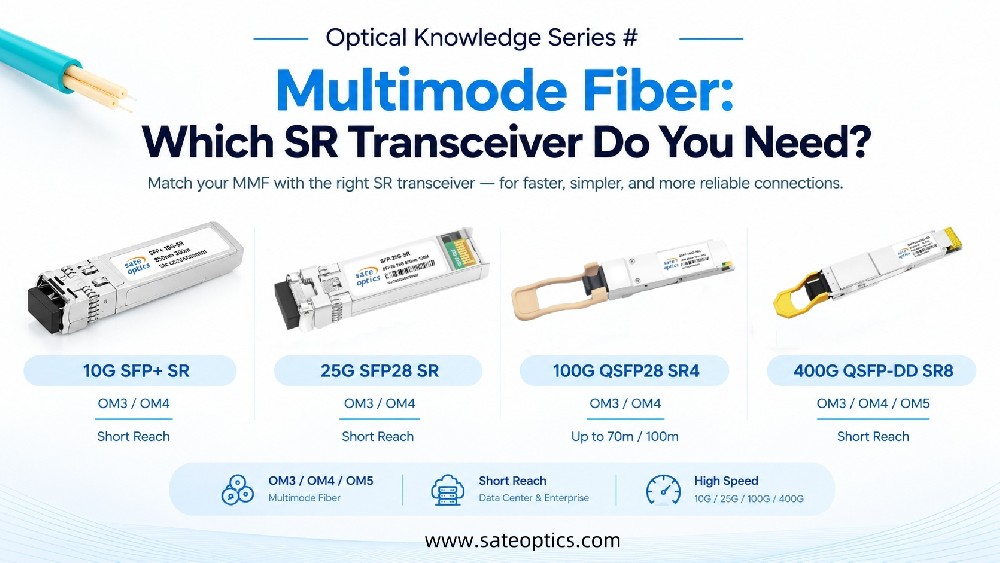
10G SR
10G LR
10G ER
10G ZR
BiDi SFP+
Typical distances:
300m (SR)
10km (LR)
40km (ER)
80km+ (ZR)
The Most Common Question
Can I insert an SFP module into an SFP+ port?
Usually:
✅ Yes
But speed will operate at 1G.
Can I insert an SFP+ module into an SFP port?
❌ No.
The switch hardware typically cannot support 10G signaling.
Always verify switch specifications before ordering.
3️⃣ QSFP (40G and Beyond)
QSFP stands for Quad Small Form-factor Pluggable.
Think of it as combining multiple high-speed lanes into one module.
Common versions include:
QSFP+ (40G)
QSFP28 (100G)
QSFP56 (200G)
QSFP-DD (400G)
OSFP (400G/800G)
These are widely used in:
Cloud data centers
AI clusters
Spine-leaf architectures
Hyperscale networks
Popular optical standards:
SR4
DR4
FR4
LR4
2xFR4
8x100G architectures
What Most Engineers Get Wrong
Mistake #1: Buying Based on Speed Alone
Many teams think:
"We'll buy 100G optics now just in case."
But if the switch ports only support 10G or 25G, the investment provides no immediate benefit.
Start with the actual network requirement.
Not the biggest number.
Mistake #2: Ignoring Distance
Speed and distance are different decisions.
For example:
A 10G link may require:
SR for 100m
LR for 10km
ER for 40km
Choosing the wrong optical standard often causes compatibility issues or unnecessary spending.
Mistake #3: Forgetting Fiber Type
One of the most common Google searches is:
"Single-mode vs multimode fiber"
Because the wrong fiber type can make an otherwise correct transceiver unusable.
Quick rule:
Multimode Fiber
Short distances
Data centers
Lower transceiver cost
Single-Mode Fiber
Long distances
Campus networks
Metro networks
Higher scalability
Mistake #4: Assuming All Modules Are Compatible
Not every transceiver works with every switch.
Many platforms require:
Vendor coding
EEPROM compatibility
Firmware recognition
Always verify compatibility before deployment.
This remains one of the largest causes of transceiver-related support tickets.
A Simpler Way to Choose
Instead of starting with module names, start with four questions:
Question 1
What speed do I need?
1G
10G
25G
40G
100G+
Question 2
How far is the link?
Within rack?
Across building?
Across campus?
Across city?
Question 3
Which fiber do I already have?
Single-mode?
Multimode?
Question 4
What does my switch support?
SFP?
SFP+?
QSFP28?
QSFP-DD?
Once these four answers are known, selecting the correct optic becomes straightforward.
The Real Cost of Choosing Wrong
Most transceiver problems aren't caused by defective optics.
They're caused by:
Wrong speed
Wrong distance specification
Wrong fiber type
Wrong compatibility coding
A few minutes of planning can prevent weeks of troubleshooting later.
And often save thousands in unnecessary hardware purchases.
Final Thoughts
The networking industry often makes transceivers sound more complicated than they really are.
But the decision usually comes down to four things:
✔ Speed
✔ Distance
✔ Fiber Type
✔ Compatibility
Get those right, and choosing between SFP, SFP+, and QSFP becomes surprisingly simple.
Frequently Searched Questions
Can SFP work in SFP+ ports?
Usually yes, at 1G speed.
Can SFP+ work in SFP ports?
Generally no.
Is QSFP faster than SFP+?
Yes. QSFP platforms support significantly higher bandwidth.
Should I always choose the fastest optic available?
Not necessarily. The best optic is the one that matches your actual network requirements.
💬 What is the most common transceiver selection mistake you've seen in real projects?
Previous:Duplex vs BiDi Optical Transceivers: Why Do Some Modules Use Two Fibers and Others Only One?
Next:1.6T Silicon Photonics Optical Transceiver: Architecture, Components and Deployment Challenges