
1.6T Silicon Photonics Optical Transceiver: Architecture, Components and Deployment Challenges
2026-06-10 22:54:14
What’s Inside a Next-Generation 1.6T Silicon Photonics Transceiver?
As artificial intelligence (AI), machine learning, and hyperscale cloud computing continue to drive unprecedented network traffic growth, the optical networking industry is accelerating toward the next milestone in data transmission: 1.6T optical transceivers.
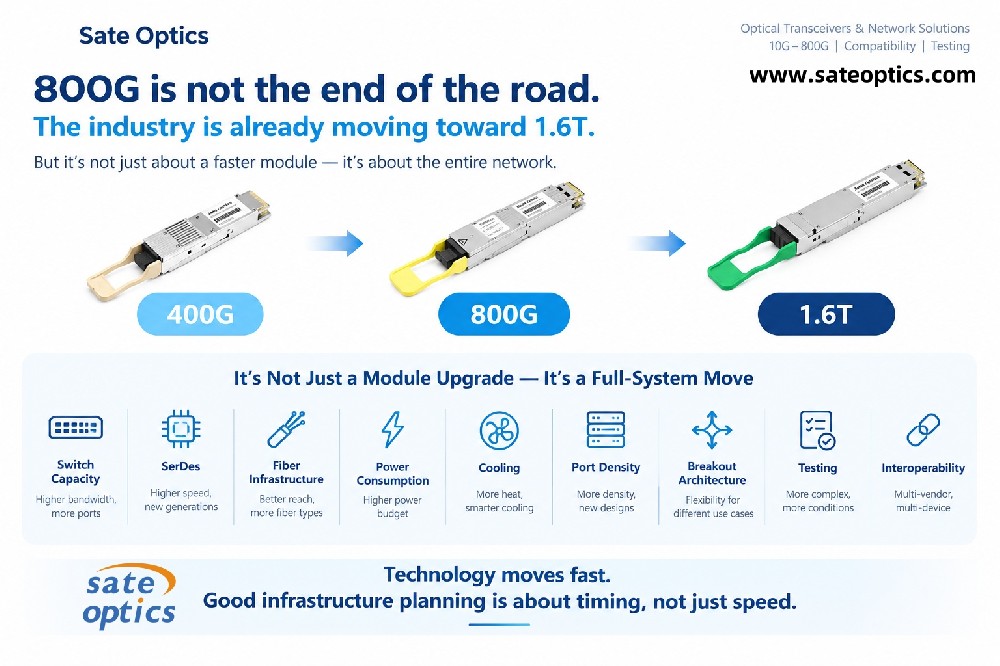
While 400G and 800G modules are rapidly becoming mainstream in modern data centers, 1.6T technology is emerging as the next-generation solution for supporting ultra-high-bandwidth AI clusters and large-scale data center interconnects (DCI).
This article explores the core architecture of a 1.6T silicon photonics optical transceiver and examines the key technologies enabling this significant leap in networking performance.
The Rise of 1.6T Optical Connectivity
The explosive growth of AI workloads has dramatically increased the demand for bandwidth between servers, switches, and GPU clusters.
As network speeds continue evolving from 100G to 400G, then to 800G, traditional optical module architectures are approaching physical and economic limitations in terms of:
Power consumption
Thermal management
Port density
Manufacturing scalability
Cost efficiency
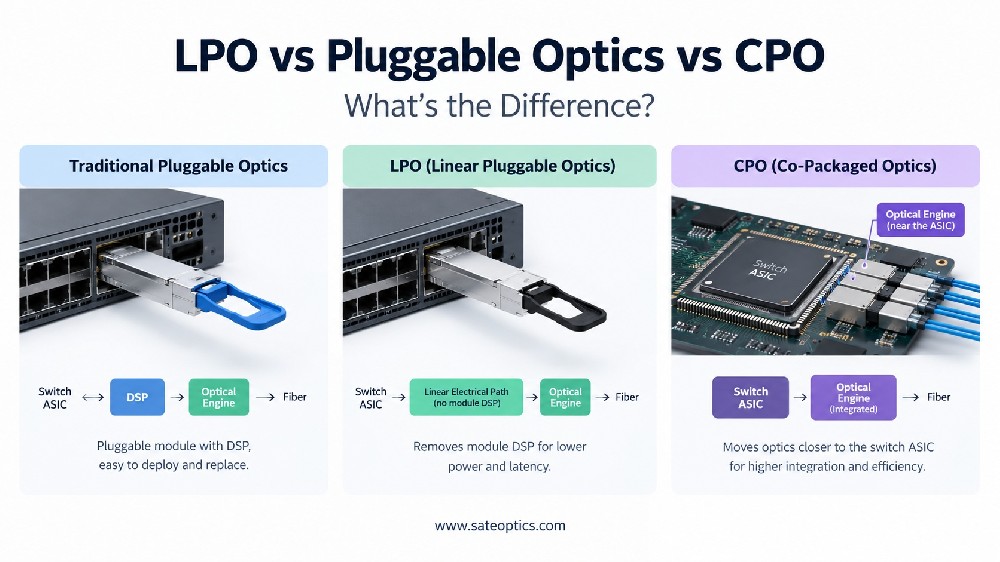
To address these challenges, the industry is increasingly turning to silicon photonics (SiPh) technology, which integrates optical functions directly onto silicon chips, enabling higher levels of performance and integration.
Core Components Inside a 1.6T Silicon Photonics Transceiver
1. Silicon Photonic Transmitter (PIC)
At the heart of the transmitter lies the Photonic Integrated Circuit (PIC).
The PIC integrates optical modulators and waveguides on a silicon platform, converting high-speed electrical signals into optical signals for transmission over fiber.
Compared with traditional discrete optical engines, silicon photonics offers:
Higher integration density
Lower power consumption
Improved manufacturing scalability
Better long-term cost efficiency
As transmission speeds continue to increase, PIC technology is becoming a key enabler for next-generation optical interconnects.
2. 1.6T Digital Signal Processor (DSP)
The DSP serves as the "brain" of the transceiver.
Its primary functions include:
Signal equalization
Forward Error Correction (FEC)
Digital signal processing
Link optimization
Compensation for transmission impairments
As data rates reach 1.6T, DSP performance becomes increasingly critical for maintaining signal integrity and transmission reliability.
However, DSPs are also among the largest contributors to overall module power consumption and heat generation.
3. Photodiode Array and Transimpedance Amplifier (TIA)
On the receiver side, incoming optical signals are first captured by a Photodiode (PD) Array.
The photodiodes convert optical signals into electrical current, which is then amplified by a Transimpedance Amplifier (TIA) before being processed by the DSP.
Together, these components play a vital role in:
Receiver sensitivity
Signal quality
Error rate performance
Overall link stability
4. Precision Fiber Assembly Units
Fiber assembly units provide the optical interface between the photonic chip and external fiber infrastructure.
Their responsibilities include:
Optical coupling
Alignment accuracy
Insertion loss control
Long-term reliability
As transmission speeds increase, even minor coupling losses can significantly impact overall system performance, making precision packaging more important than ever.
Why Silicon Photonics Matters for 1.6T
The transition from discrete optical architectures to highly integrated silicon photonics platforms is reshaping the future of optical networking.
Key advantages include:
Higher Port Density
Silicon photonics enables more optical functionality to be integrated into smaller form factors, supporting the growing demand for bandwidth within data centers.
Improved Power Efficiency
Integration reduces the number of discrete components, helping lower overall power consumption per transmitted bit.
Better Scalability
Silicon-based manufacturing processes offer a path toward higher-volume production and improved cost efficiency.
Support for AI Infrastructure
Large AI clusters require massive east-west traffic between servers and accelerators, making high-density optical interconnects essential.
Challenges Facing Large-Scale 1.6T Deployment
Although 1.6T transceivers represent a major technological advancement, several challenges remain before widespread commercial adoption can occur.
Power Consumption
Higher data rates require increasingly powerful DSPs and optical engines, which can significantly increase module power requirements.
Thermal Management
As power consumption rises, removing heat efficiently becomes one of the industry's most pressing engineering challenges.
Advanced Packaging
Integrating DSPs, PICs, lasers, TIAs, and fiber assemblies into compact form factors requires sophisticated packaging technologies.
Manufacturing Yield
Achieving consistent performance across high-volume production remains critical for cost-effective deployment.
Ecosystem Readiness
Switch ASICs, network architectures, and data center infrastructure must continue evolving to fully support 1.6T connectivity.
Looking Ahead
The move from 400G to 800G and now to 1.6T represents more than just a speed upgrade—it reflects a fundamental shift toward highly integrated optical networking architectures.
Silicon photonics is expected to play a central role in enabling future generations of AI infrastructure, cloud computing platforms, and hyperscale data centers.
While challenges related to power, thermal design, and manufacturing remain, ongoing innovation across the optical ecosystem is steadily bringing 1.6T technology closer to mainstream deployment.
As the industry continues pushing the boundaries of bandwidth and efficiency, 1.6T silicon photonics transceivers are poised to become a cornerstone of next-generation data center networks.
Previous:Making the Right Choice Between SFP, SFP+, and QSFP — Save Cost and Avoid Compatibility Issues
Next:What Do 850nm, 1310nm and 1550nm Mean in Optical Transceivers?