
What Do 850nm, 1310nm and 1550nm Mean in Optical Transceivers?
2026-06-16 20:56:01
What Do 850nm, 1310nm and 1550nm Actually Mean in Optical Transceivers?
Understanding Optical Wavelengths and How They Affect Fiber Network Performance
When selecting an optical transceiver, most buyers focus on speed:
1G
10G
25G
40G
100G
400G
However, another specification is equally important but often misunderstood:
850nm, 1310nm, and 1550nm.
These numbers appear on SFP, SFP+, SFP28, QSFP28, QSFP-DD, and other optical transceivers, yet many network engineers, IT managers, and procurement teams are unsure what they actually mean.
Understanding optical wavelengths can help you select the right transceiver, fiber type, and transmission distance while avoiding costly deployment mistakes.
What Does "nm" Mean?
"nm" stands for nanometer, which is a unit used to measure the wavelength of light.
In fiber optic communication, data is transmitted as pulses of light through optical fiber.
Different wavelengths travel differently inside fiber and are optimized for different transmission distances and applications.
Think of it this way:
Fiber cable = Highway
Data = Vehicles
Wavelength = Type of vehicle traveling on the highway
Different wavelengths are designed for different networking scenarios.
850nm Optical Transceivers
Typical Fiber Type
850nm transceivers are primarily used with:
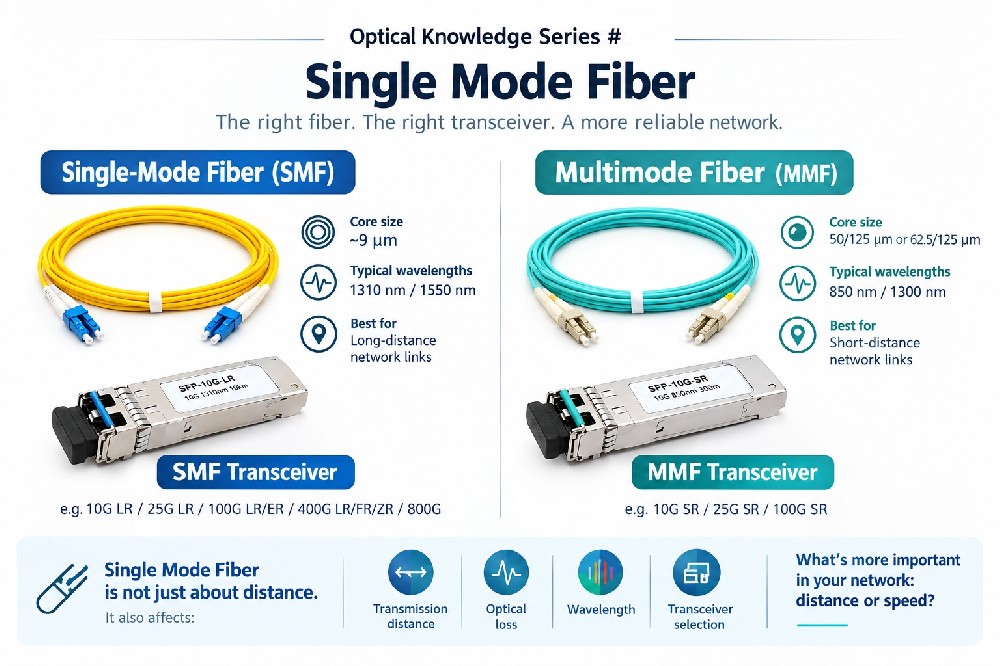
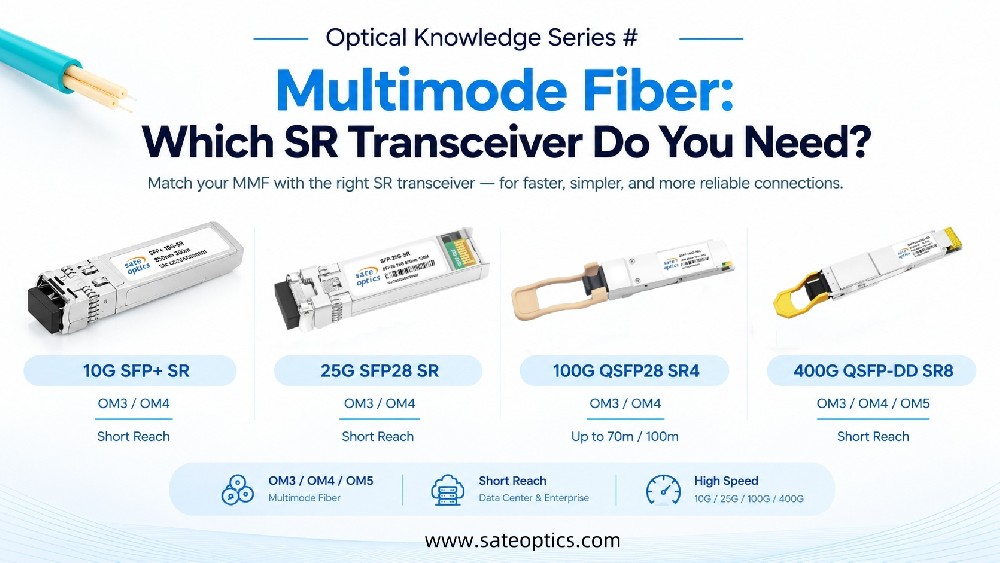
OM3 Multimode Fiber
OM4 Multimode Fiber
OM5 Multimode Fiber
Common Optical Modules
Examples include:
1G SX SFP
10G SR SFP+
25G SR SFP28
40G SR4 QSFP+
100G SR4 QSFP28
400G SR8 QSFP-DD
Typical Transmission Distance
| Fiber Type | Typical Distance |
|---|---|
| OM3 | Up to 300m |
| OM4 | Up to 400m |
| OM5 | Similar to OM4 for most applications |
Typical Applications
850nm optics are commonly used in:
Data centers
Enterprise server rooms
Storage networks
High-density rack-to-rack connections
Why Choose 850nm?
Advantages include:
Lower transceiver cost
Lower multimode cabling cost
Ideal for short-distance deployments
However, multimode fiber is generally not suitable for long-distance transmission.
1310nm Optical Transceivers
Typical Fiber Type
1310nm modules typically operate over:
OS1 Single Mode Fiber
OS2 Single Mode Fiber
Common Optical Modules
Examples include:
1G LX SFP
10G LR SFP+
25G LR SFP28
100G LR4 QSFP28
400G DR4 QSFP-DD
Typical Transmission Distance
Common distances include:
10km
20km
40km (depending on module design)
Typical Applications
1310nm optics are widely used in:
Campus networks
Enterprise backbones
Metropolitan area networks
Inter-building connections
Why Choose 1310nm?
1310nm offers a good balance between:
Cost
Distance
Performance
For many enterprise and campus networks, it is the most common single-mode wavelength.
1550nm Optical Transceivers
Typical Fiber Type
1550nm optics are designed for:
OS1 Single Mode Fiber
OS2 Single Mode Fiber
Common Optical Modules
Examples include:
10G ER SFP+
10G ZR SFP+
DWDM SFP/SFP+
Long-haul telecom optics
Typical Transmission Distance
Depending on module type:
40km
80km
100km
120km+
Typical Applications
1550nm is commonly deployed in:
Telecom networks
ISP backbone networks
Long-distance enterprise links
Carrier transmission systems
Why Can 1550nm Reach Further?
The answer lies in fiber attenuation.
Optical fiber experiences less signal loss around the 1550nm wavelength range.
Benefits include:
Lower attenuation
Longer transmission distance
Better performance for long-haul communication
This is one reason why DWDM systems commonly operate near the 1550nm window.
What About 1490nm?
1490nm is frequently used in:
BiDi optical transceivers
GPON networks
EPON networks
FTTH deployments
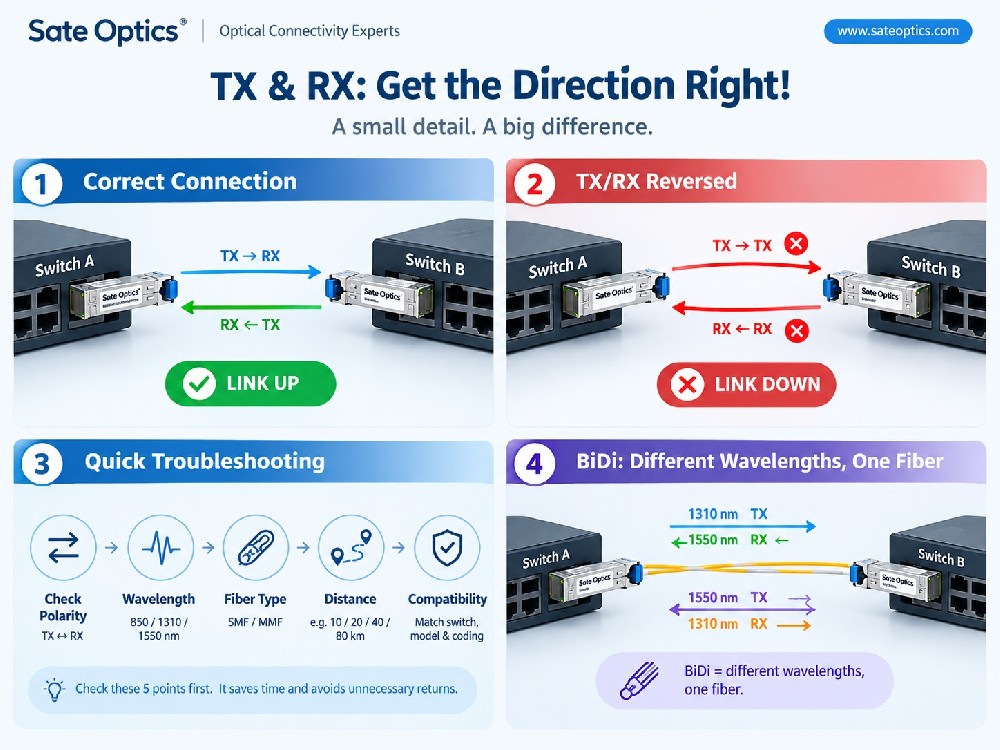
Instead of using two fibers, BiDi transceivers transmit and receive data over a single fiber using different wavelengths.
For example:
| Side A | Side B |
|---|---|
| TX 1310nm / RX 1490nm | TX 1490nm / RX 1310nm |
This allows full-duplex communication while reducing fiber consumption by 50%.
Typical Applications
Fiber-to-the-Home (FTTH)
Access networks
Passive Optical Networks (PON)
Fiber infrastructure projects
Why Wavelength Matters When Choosing an Optical Transceiver
Many buyers focus only on speed and connector type.
For example:
10G SFP+
LC connector
Single mode fiber
But this information alone is not enough.
You must also verify:
Transmission Distance
A 10G SR module and a 10G LR module both provide 10Gbps speeds, but their supported distances are completely different.
Fiber Type
850nm modules require multimode fiber, while 1310nm and 1550nm modules generally require single-mode fiber.
Network Architecture
Different wavelengths are designed for different network environments, such as:
Data centers
Enterprise campuses
Metro networks
Telecom backbones
FTTH deployments
Selecting the wrong wavelength can result in link failures, poor performance, or unnecessary costs.
Quick Comparison: 850nm vs 1310nm vs 1550nm
| Wavelength | Fiber Type | Typical Distance | Common Use |
|---|---|---|---|
| 850nm | Multimode | 100m–400m | Data Centers |
| 1310nm | Single Mode | Up to 10km+ | Campus & Enterprise |
| 1550nm | Single Mode | 40km–120km+ | Telecom & Long-Haul |
| 1310nm + 1490nm | Single Mode | Varies | BiDi & FTTH |
How to Choose the Right Wavelength
Before purchasing optical transceivers, ask these four questions:
1. What transmission distance is required?
Under 300m → 850nm SR optics
Around 10km → 1310nm LR optics
Over 40km → 1550nm ER/ZR optics
2. What fiber is already installed?
Existing cabling often determines which wavelength can be used.
3. Is fiber availability limited?
If fiber resources are limited, BiDi transceivers may be a better choice.
4. Will the network need future upgrades?
Selecting the right wavelength strategy today can simplify future bandwidth expansion.
Conclusion
850nm, 1310nm, and 1550nm are more than just numbers printed on an optical transceiver.
They determine:
Which fiber type can be used
How far the signal can travel
Which network environments the transceiver is designed for
As a simple rule:
✅ 850nm = Short Distance + Multimode Fiber
✅ 1310nm = Medium Distance + Single Mode Fiber
✅ 1550nm = Long Distance + Lowest Fiber Loss
✅ 1310nm + 1490nm = BiDi and FTTH Applications
Understanding these wavelengths makes it much easier to select the correct optical transceiver and build a more reliable fiber network.
Previous:1.6T Silicon Photonics Optical Transceiver: Architecture, Components and Deployment Challenges
Next:Why Are Data Centers Moving from 100G to 400G Optical Transceivers?