
Why Are Data Centers Moving from 100G to 400G Optical Transceivers?
2026-06-18 11:37:09
Why Are Data Centers Moving from 100G to 400G Optical Transceivers?
AI, Cloud Computing and Hyperscale Networks Are Driving the Next Upgrade Cycle
As artificial intelligence, cloud computing, and hyperscale data centers continue to expand, network bandwidth requirements are growing at an unprecedented rate.
A few years ago, 100G optical transceivers were considered the mainstream choice for modern data centers. Today, however, many leading cloud providers and AI infrastructure operators are accelerating deployments of 400G optical transceivers, while some are already planning for 800G networks.
So why is the industry moving from 100G to 400G?
The answer is not simply about faster speeds. It is about improving network efficiency, increasing port density, reducing operational complexity, and preparing infrastructure for future workloads.
The Rise of AI Is Changing Data Center Traffic Patterns
Traditional data centers primarily handled north-south traffic, where data moved between users and servers.
AI clusters operate differently.
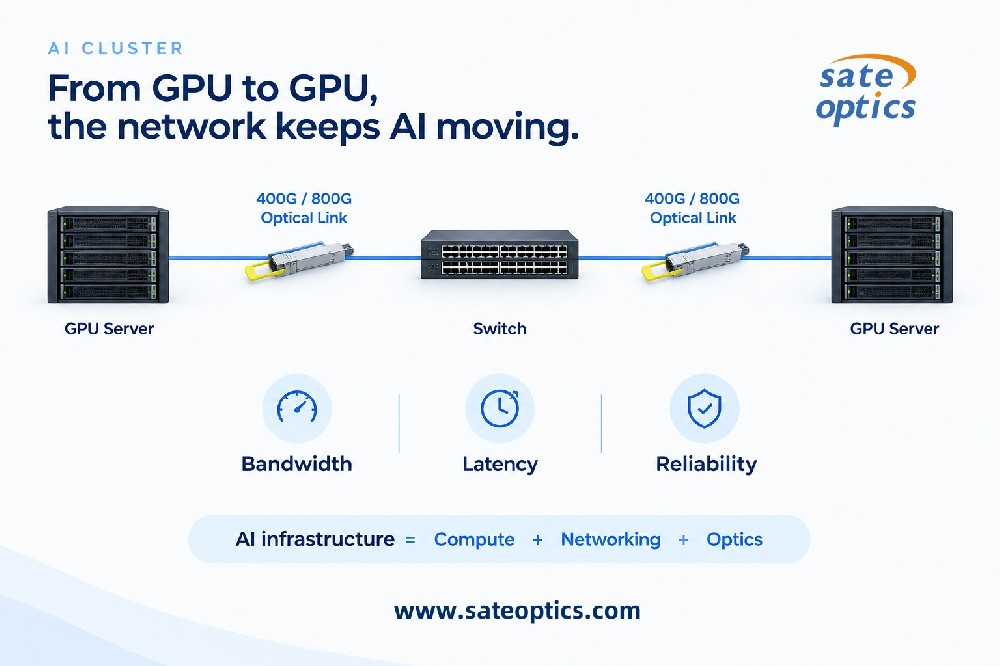
Modern AI training and inference workloads generate massive east-west traffic between GPU servers, storage systems, and network switches.
For example, large-scale AI deployments based on NVIDIA GPU clusters may involve thousands of interconnected servers exchanging enormous amounts of data simultaneously.
As AI models continue to grow, network bandwidth requirements increase significantly.
This is one of the biggest reasons why many organizations are upgrading from 100G to 400G optical connectivity.
Benefits of 400G for AI Networks
Higher throughput between GPU clusters
Reduced network bottlenecks
Faster model training times
Improved scalability for future AI expansion
Better utilization of high-performance computing resources
Cloud Services Continue to Drive Bandwidth Growth
The demand for cloud infrastructure is expanding across nearly every industry.
Applications such as:
Artificial Intelligence
Video Streaming
Cloud Storage
Big Data Analytics
SaaS Platforms
Edge Computing
all require larger amounts of network bandwidth than ever before.
As traffic volumes grow, cloud providers must find ways to increase capacity without dramatically increasing power consumption, rack space, and operational complexity.
400G optical transceivers provide a practical solution.
Instead of deploying multiple 100G links, operators can consolidate traffic onto fewer high-speed connections.
Why Not Simply Use More 100G Links?
At first glance, using four 100G links to achieve 400G seems reasonable.
However, large-scale data centers face challenges that go beyond bandwidth alone.
Using Multiple 100G Links Requires:
More switch ports
More fiber cabling
More patch panels
More transceivers
More power consumption
More network management resources
As networks scale to thousands of servers, these additional costs become significant.
A single 400G connection can often replace multiple 100G links, simplifying infrastructure and reducing operational overhead.
Higher Port Density Matters
Modern data centers aim to maximize bandwidth within limited rack space.
400G technology allows network operators to increase bandwidth per rack unit without increasing the number of physical ports.
Example
A 32-port switch can provide:
3.2Tbps with 100G ports
12.8Tbps with 400G ports
This significant increase in bandwidth density helps cloud providers support larger workloads while reducing infrastructure footprint.
For hyperscale environments, port density is often just as important as raw speed.
Lower Cost Per Bit
One of the most important purchasing considerations for data center operators is cost per transmitted bit.
Although a 400G optical transceiver costs more than a 100G module, the overall network economics are often more favorable.
Benefits include:
Fewer transceivers required
Fewer switch ports required
Lower cabling costs
Reduced power consumption
Simplified maintenance
As a result, many operators achieve a lower total cost of ownership (TCO) when deploying 400G infrastructure.
Common 400G Optical Transceiver Types
Different deployment scenarios require different optical solutions.
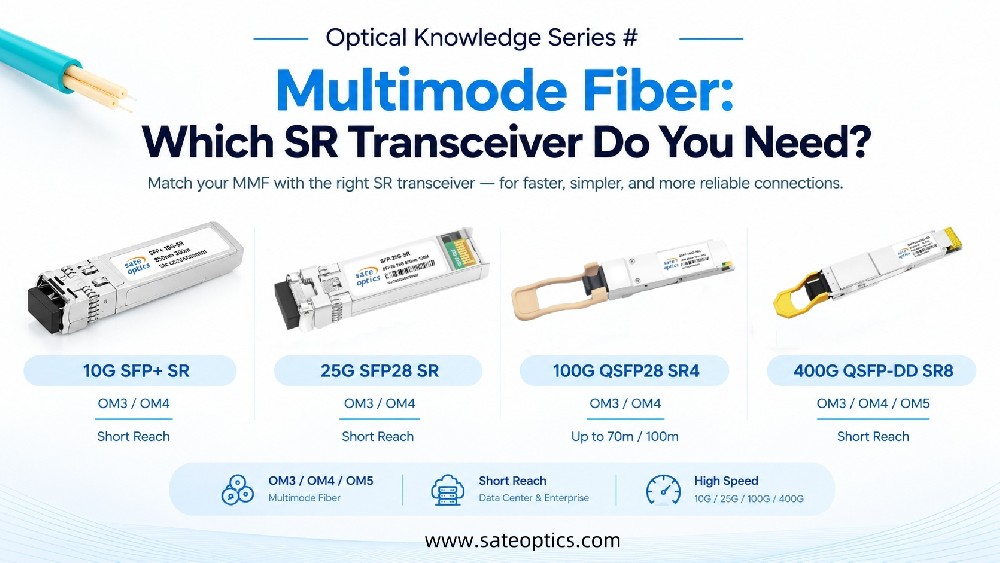
400G QSFP-DD SR8
Fiber Type: Multimode Fiber (MMF)
Distance: Up to 100m
Connector: MPO-16
Typical Applications:
AI clusters
Data centers
High-density server interconnects
400G QSFP-DD DR4
Fiber Type: Single Mode Fiber (SMF)
Distance: Up to 500m
Connector: MPO-12
Typical Applications:
Spine-leaf architecture
Intra-data-center links
400G QSFP-DD FR4
Fiber Type: Single Mode Fiber (SMF)
Distance: Up to 2km
Connector: Duplex LC
Typical Applications:
Campus networks
Large enterprise data centers
400G QSFP-DD LR4
Fiber Type: Single Mode Fiber (SMF)
Distance: Up to 10km
Connector: Duplex LC
Typical Applications:
Data center interconnection (DCI)
Metro connectivity
Will 100G Disappear?
Not at all.
100G optical transceivers remain one of the most widely deployed solutions worldwide and will continue serving many applications for years.
Typical scenarios where 100G remains a strong choice include:
Enterprise networks
ISP backbones
Campus networks
Medium-sized data centers
Cost-sensitive deployments
However, for AI infrastructure, cloud platforms, and hyperscale environments, 400G is rapidly becoming the preferred option.
The Future Is Already Moving Toward 800G
The same factors that accelerated the transition from 10G to 25G and from 25G to 100G are now driving the move from 100G to 400G.
Those factors include:
AI-driven workloads
Explosive cloud growth
Increasing port density requirements
Lower cost per bit
Improved power efficiency
Simplified cabling architecture
As network demand continues to rise, many organizations are already evaluating 800G optical transceivers for next-generation deployments.
The transition from 100G to 400G is not simply a speed upgrade—it is a strategic step toward building more scalable, efficient, and future-ready data center networks.
Why Choose Sate Optics?
At Sate Optics, we provide a complete portfolio of high-performance optical transceivers ranging from 1G to 800G, including:
100G QSFP28 SR4, LR4, ER4 and ZR4
400G QSFP-DD SR8, DR4, FR4 and LR4
800G QSFP-DD and OSFP solutions
DAC and AOC cables
MPO fiber connectivity products
All products undergo rigorous testing to ensure reliable interoperability with leading network equipment vendors.
Sate Optics – Optical Connectivity Experts
Website: www.sateoptics.com
Previous:What Do 850nm, 1310nm and 1550nm Mean in Optical Transceivers?
Next:🔷 How to Upgrade from 10G to 100G Without Overspending | Data Center Network Upgrade Guide