
PAM4 Explained: What Is PAM4 in 50G, 100G, 400G & 800G Ethernet?
2026-09-01 17:37:01
PAM4 Explained: Why Modern Ethernet Needs More Than 0s and 1s
PAM4 is becoming an important signaling technology for high-speed Ethernet. Here’s how it works, why it matters for 50G/100G/200G/400G/800G networking, and what to check before choosing a PAM4 optical transceiver.
As Ethernet speeds continue to increase, simply sending more 0s and 1s is no longer the whole story.
This is where PAM4 comes in.
PAM4 is one of the key signaling technologies behind many modern high-speed Ethernet interfaces. It allows more information to be carried in each symbol, helping network designers increase data rates while keeping the number of physical lanes manageable.
But what exactly is PAM4?
And more importantly, why should optical transceiver buyers care about it?
What Is PAM4?
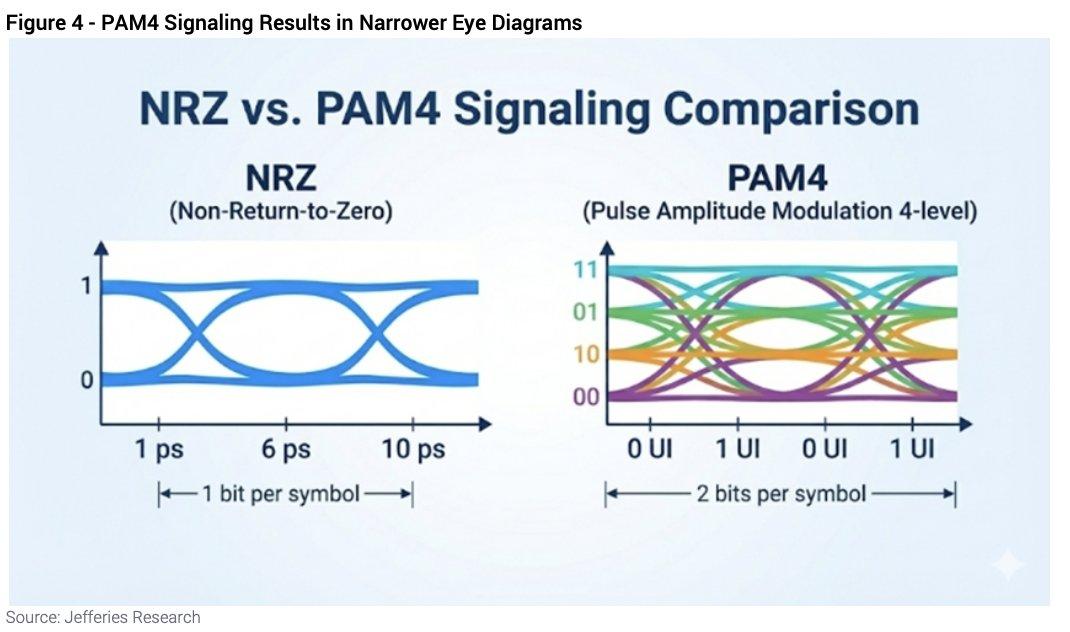
PAM4 stands for Pulse Amplitude Modulation with 4 levels.
Traditional NRZ (Non-Return-to-Zero) signaling uses two signal levels to represent binary information:
0
1
PAM4 uses four different signal levels.
These four levels can represent four combinations:
| Signaling | Signal Levels | Bits per Symbol |
|---|---|---|
| NRZ | 2 | 1 |
| PAM4 | 4 | 2 |
In simple terms:
NRZ → 1 bit per symbol
PAM4 → 2 bits per symbol
This allows PAM4 to carry more information per symbol without simply doubling the number of physical lanes.
Why Does Modern Ethernet Use PAM4?
The main reason is higher data rates per lane.
As Ethernet moved from 10G and 25G toward 100G, 200G, 400G and 800G, increasing the data rate of each individual electrical or optical lane became increasingly important.
PAM4 effectively doubles the number of bits represented by each symbol compared with NRZ.
That makes it possible to achieve higher lane rates while keeping the overall system architecture practical.
This is particularly relevant to:
50G Ethernet
100G Ethernet
200G Ethernet
400G Ethernet
800G Ethernet
However, an important point is that not every interface at these speeds necessarily uses PAM4. The actual signaling method depends on the Ethernet PHY, interface design, transceiver architecture and platform.
So, speed alone does not tell you whether an optic uses PAM4.
PAM4 vs. NRZ: What Is the Trade-Off?
PAM4 provides higher information density, but there is a trade-off.
With NRZ, there are only two signal levels.
With PAM4, there are four.
That means the difference between adjacent signal levels is smaller.
As a result, PAM4 systems can be more sensitive to:
Noise
Signal distortion
Crosstalk
Loss
Receiver performance
Overall signal integrity
This is one reason why high-speed PAM4 optical links require careful system design.
More bits per symbol does not mean “free bandwidth.”
It comes with additional requirements for signal quality and link design.
Why Does PAM4 Matter When Choosing an Optical Transceiver?
This is where PAM4 becomes more than a technical term.
When purchasing a high-speed optical transceiver, looking only at:
“400G”
or
“800G”
is not enough.
You also need to understand the signaling and system requirements behind that speed.
Before choosing a PAM4 optical transceiver, check:
1. PAM4 or NRZ?
Confirm the signaling technology required by the host platform.
2. FEC requirements
PAM4-based systems commonly rely on FEC as part of the overall link design, but the exact FEC requirement depends on the interface and platform.
3. Switch compatibility
The optical module must match the host switch or networking platform.
4. NIC compatibility
For server and AI infrastructure, the NIC side also needs to be considered.
5. Fiber type and distance
Check whether the application requires SR, DR, FR, LR or another optical reach.
6. Lane architecture
A “400G” optic can use different lane configurations and optical architectures.
This is especially important when comparing different 400G and 800G transceiver types.
PAM4 and 400G QSFP-DD Optical Transceivers
PAM4 is particularly relevant when discussing 400G QSFP-DD optical transceivers.
For example, 400G QSFP-DD products can include different optical architectures such as:
400G QSFP-DD SR8
400G QSFP-DD DR4
400G QSFP-DD DR4+
400G QSFP-DD FR4
400G QSFP-DD LR4
These products are designed for different distances and network applications.
The important point is:
400G is the data rate. PAM4 is the signaling technology.
They describe different aspects of the system.
Therefore, when comparing 400G optical transceivers, don't treat “400G” and “PAM4” as interchangeable terms.
PAM4 in Data Center and AI Networks
The importance of PAM4 becomes even more apparent as data center network speeds continue to increase.
Modern applications such as:
AI clusters
GPU networking
High-performance computing
Data center spine-leaf networks
Server-to-switch connections
Switch-to-switch interconnects
are pushing networks toward higher bandwidth.
As a result, 100G, 400G and 800G optical transceivers are becoming increasingly important components of high-speed network infrastructure.
For these applications, choosing the correct optic requires looking beyond the headline data rate.
The complete system should be considered:
Switch → NIC → Transceiver → Fiber → Distance → FEC
A Simple Way to Remember PAM4
If you only remember one thing from this article, remember this:
NRZ uses 2 signal levels. PAM4 uses 4 signal levels.
And:
NRZ carries 1 bit per symbol, while PAM4 can carry 2 bits per symbol.
That higher information density helps enable modern high-speed Ethernet—but it also makes signal quality and system compatibility more important.
FAQ: PAM4 Optical Transceivers
Is PAM4 the same as 400G?
No.
400G describes the data rate of the interface.
PAM4 describes the signaling method.
A 400G interface may use PAM4, but the exact implementation depends on the Ethernet PHY and platform.
Is PAM4 better than NRZ?
Not simply “better.”
PAM4 can provide higher data rates per lane, but it also introduces greater sensitivity to signal quality and requires appropriate system design.
Which Ethernet speeds use PAM4?
PAM4 is used in many modern high-speed Ethernet implementations, including various 50G, 100G, 200G, 400G and 800G interfaces.
However, the exact signaling method depends on the specific standard and implementation.
Does PAM4 require FEC?
Many PAM4-based high-speed Ethernet systems use FEC, but the exact requirement depends on the PHY, interface and platform.
Always check the host system's specifications before deployment.
Can I choose a PAM4 optical transceiver just by looking at the speed?
No.
You should also verify:
signaling → FEC → switch/NIC compatibility → fiber → distance → optical architecture.
Choosing the Right High-Speed Optical Transceiver
At Sate Optics, we provide optical transceiver solutions for different network speeds and application requirements, including 100G, 400G and 800G optical transceivers.
Our product portfolio includes solutions such as:
400G QSFP-DD SR8
400G QSFP-DD DR4
400G QSFP-DD DR4+
400G QSFP-DD FR4
400G QSFP-DD LR4
100G optical transceivers
800G optical transceivers
The right model depends on your switch platform, transmission distance, fiber type, lane architecture and application requirements.
Need help selecting the right 100G, 400G or 800G optical transceiver?
Send us your switch/NIC model, required distance and target data rate, and our team can help you identify a suitable solution.
Explore Sate Optics optical transceiver solutions or contact us for a product recommendation.
Previous:Optical Transceivers Are Becoming a Supply Chain Decision | Sate Optics
Next:Can You Plug Any SFP Into Any Switch? SFP Compatibility Guide