
A Simple Guide to SFPs, DAC AOC Cables, RJ45, CWDM, DWDM and Network Speeds (1G–800G)
2025-12-31 14:55:46
A Simple Guide to SFPs, DAC AOC Cables, RJ45, CWDM, DWDM and Network Speeds (1G–800G)
When you hear terms like SFP, DAC, AOC, CWDM, DWDM, or 100G, it can feel confusing at first. These technologies are widely used in data centers, ISPs, cloud platforms, and enterprise networks.
This guide breaks them down in a simple, practical way—no engineering background required.
What Are SFP, SFP+, SFP28, and QSFP Modules?
These are pluggable transceiver modules used in switches, routers, servers, and transmission equipment to connect networks over fiber or copper.
Think of them as the “SIM cards” of high-speed networking—you plug them in to activate a specific speed and distance.
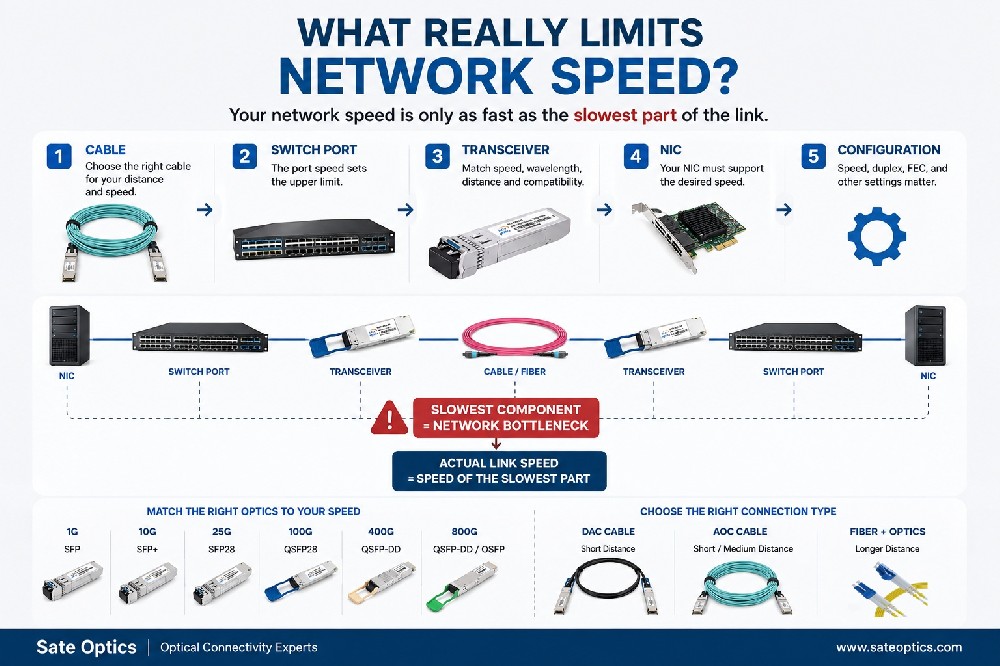
Common Transceiver Types Explained
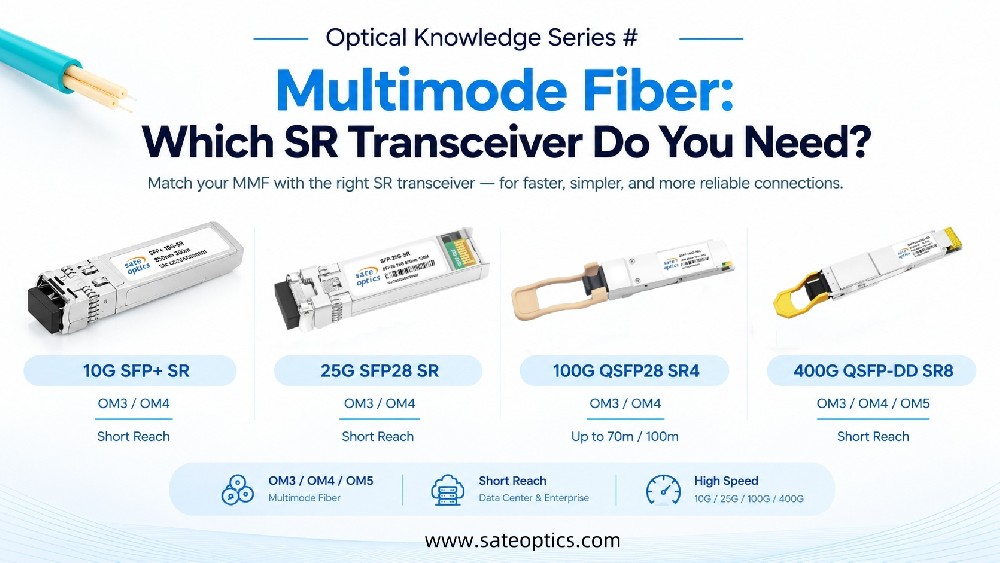
SFP (1G)
Used for 1 Gigabit Ethernet connections.SFP+ (10G)
Supports 10 Gigabit Ethernet, common in enterprise and ISP networks.SFP28 (25G)
Designed for modern 25G server and cloud infrastructure.QSFP+ (40G)
QSFP means Quad SFP, combining four lanes into one 40G link.QSFP28 (100G)
Widely used in data centers and carrier networks.QSFP56 (200G) / QSFP-DD (400G)
Used in high-performance computing and hyperscale environments.QSFP-DD / OSFP (800G)
Next-generation modules for ultra-high throughput, AI-driven data centers, and backbone networks.
These modules can work over fiber optic cables or copper, depending on the application.
RJ45 — The Ethernet Connector Everyone Knows
RJ45 is the standard Ethernet connector used in homes, offices, and many ISP access networks.
Key Characteristics of RJ45
Commonly supports 1G Ethernet
Can support 10G using Cat6A or Cat8 cables
Limited transmission distance
Higher signal loss compared to fiber
RJ45 is simple and familiar, but not ideal for long-distance or ultra-high-speed networking.
DAC Cables (Direct Attach Copper)
DAC cables are pre-terminated copper cables with SFP or QSFP connectors on both ends. They do not require separate transceiver modules.
Why DAC Is So Popular in Data Centers
Much cheaper than fiber solutions
Ultra-low latency
Plug-and-play simplicity
Ideal for short distances (typically 1–7 meters)
DAC cables are widely used for switch-to-server and switch-to-switch connections inside data centers.
AOC Cables (Active Optical Cables)
AOC (Active Optical Cable) looks similar to DAC but uses fiber optics instead of copper. The transceivers are built directly into the cable ends, so no separate modules are needed.
Why Use AOC?
Longer reach than DAC (typically up to 100 meters)
Lighter and thinner than copper cables
Lower signal loss
Resistant to electromagnetic interference
Easy plug-and-play deployment
AOC is commonly used for data center interconnects, especially when distances are too long for DAC but full optical transceivers are not required.
CWDM vs. DWDM — What’s the Difference?
CWDM and DWDM are wavelength-division multiplexing technologies that allow multiple signals to travel over a single fiber—dramatically reducing fiber costs.
CWDM (Coarse Wavelength Division Multiplexing)
Fewer wavelengths
Lower cost equipment
Medium-distance transmission
Common in metro networks and ISP aggregation
DWDM (Dense Wavelength Division Multiplexing)
Supports many more wavelengths
Extremely high capacity
Very long-distance transmission
Used for backbone, long-haul, and submarine networks
Higher cost, but extremely powerful
Simple analogy:
CWDM is like a local train 🚆, while DWDM is a high-speed bullet train 🚄.
Understanding Network Speeds: From 1G to 800G
Here’s a simplified overview of network speeds, technologies, and typical use cases:
| Speed | Technology | Common Applications |
|---|---|---|
| 1G | SFP, RJ45 | Home ISPs, small offices |
| 10G | SFP+ | Enterprises, ISPs, data centers |
| 25G | SFP28 | Cloud servers, modern data centers |
| 40G | QSFP+ | Aggregation layers |
| 100G | QSFP28 | Data centers, carrier networks |
| 200G | QSFP56 | High-performance computing |
| 400G | QSFP-DD | Hyperscale cloud, ISP backbone |
| 800G | QSFP-DD / OSFP | Next-gen AI data centers, core networks |
As speeds increase, networks gain the bandwidth needed for cloud computing, virtualization, CDN, AI workloads, and content delivery.
Final Thoughts
Understanding SFPs, DAC cables, AOC, CWDM, DWDM, and network speeds helps businesses make smarter infrastructure decisions—whether for a small enterprise or a global data center.
As networks evolve from 1G to 800G, choosing the right technology becomes more critical than ever.
#SFP #SFP28 #QSFP #QSFP28 #QSFPDD #OSFP #RJ45 #1G #10G #25G #40G #100G #200G #400G #800G #CWDM #DWDM #DAC #AOC #OpticalTransceiver #DataCenter #ISP #CloudNetworking
Previous:🚀“Decoding Optical Transceivers: What’s the Difference Between SFP, SFP+, and SFP28?”⁉️
Next:400G QSFP-DD Optical Modules: SR8 vs DR4 vs FR4 vs LR4 vs ER4 Explained