
10G Optical Module Guide: Compare LRM, SR, LR, ER, ZR for the Right Choice
2026-02-03 23:12:42
10G Optical Module Guide: Compare LRM, SR, LR, ER, ZR for the Right Choice
As 10G Ethernet continues to be widely deployed in data centers, enterprise networks, and telecom infrastructures, choosing the right 10G optical module is critical for performance, cost control, and long-term scalability.
Among the most common options are 10G SR, LRM, LR, ER, and ZR modules.
Although they all support 10Gbps transmission, their fiber type, distance, wavelength, and application scenarios are very different.
This guide explains each type in a clear and practical way—helping you make the right choice for your network.
What Is a 10G Optical Module?
A 10G optical module (also called 10G transceiver or SFP+ module) converts electrical signals into optical signals for high-speed data transmission over fiber optic cables.
Typical applications include:
Data center interconnections
Enterprise core and aggregation networks
Telecom and metro networks
Cloud and AI infrastructure
Overview: 10G Optical Module Types Comparison
| Module Type | Wavelength | Fiber Type | Max Distance | Typical Use Case |
|---|---|---|---|---|
| 10G SR | 850nm | MMF | 300m | Data center short links |
| 10G LRM | 1310nm | MMF | 220m | Legacy MMF upgrade |
| 10G LR | 1310nm | SMF | 10km | Campus & metro |
| 10G ER | 1550nm | SMF | 40km | Long-distance links |
| 10G ZR | 1550nm | SMF | 80km+ | Telecom & backbone |
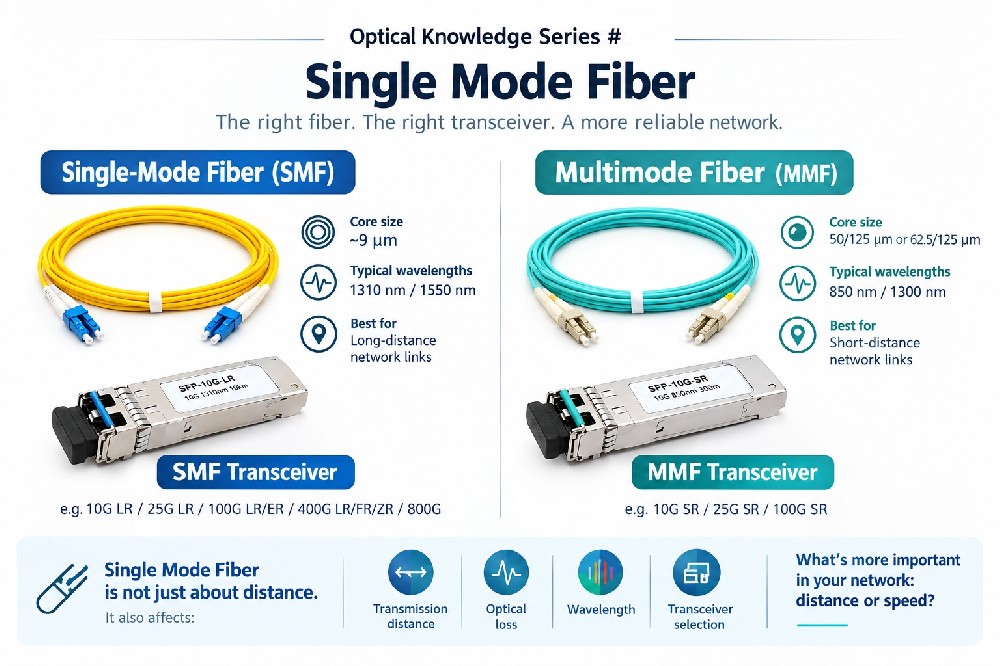
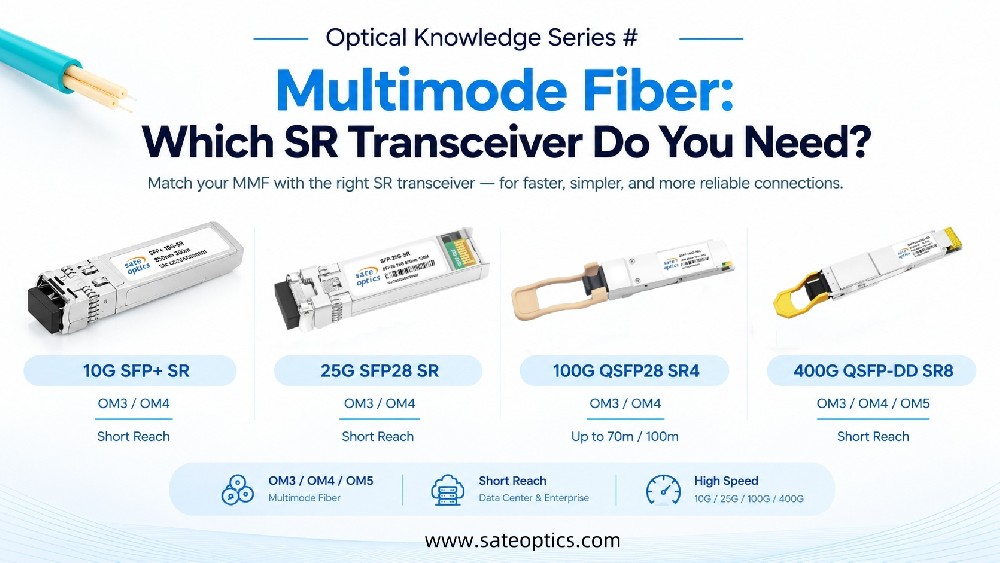
1. 10G SR Optical Module (Short Reach)
10G SR is the most commonly used 10G module in data centers.
Key Features
Wavelength: 850nm
Fiber: Multimode fiber (OM3 / OM4)
Distance:
Up to 300m on OM3
Up to 400m on OM4
Typical Applications
Data center switch-to-switch links
Server-to-switch connections
High-density short-distance deployments
Why choose SR?
✅ Lowest cost
✅ Low power consumption
❌ Limited distance
2. 10G LRM Optical Module (Long Reach Multimode)
10G LRM was designed to extend 10G transmission over existing legacy multimode fiber.
Key Features
Wavelength: 1310nm
Fiber: Multimode fiber (OM1 / OM2 / OM3)
Distance: Up to 220m
Typical Applications
Upgrading old data centers without replacing MMF
Enterprise networks with legacy cabling
Why choose LRM?
✅ Works on old MMF
❌ Higher cost than SR
❌ Becoming less common in new deployments
3. 10G LR Optical Module (Long Reach)
10G LR is the standard choice for single-mode 10G transmission.
Key Features
Wavelength: 1310nm
Fiber: Single-mode fiber (SMF)
Distance: Up to 10km
Typical Applications
Campus networks
Metro Ethernet
Data center interconnection (DCI)
Why choose LR?
✅ Excellent balance of cost and distance
✅ Very common and widely supported
4. 10G ER Optical Module (Extended Reach)
10G ER is used when transmission distance exceeds 10km.
Key Features
Wavelength: 1550nm
Fiber: Single-mode fiber
Distance: Up to 40km
Typical Applications
Long-distance enterprise links
Metro and access networks
Service provider infrastructure
Why choose ER?
✅ Long-distance capability
❌ Higher cost and power consumption
5. 10G ZR Optical Module (Z Reach)
10G ZR supports ultra-long-distance transmission and is commonly used in telecom networks.
Key Features
Wavelength: 1550nm
Fiber: Single-mode fiber
Distance: 80km or more (depending on link budget)
Typical Applications
Telecom backbone networks
Long-haul fiber links
Critical infrastructure
Why choose ZR?
✅ Maximum distance
❌ Highest cost
❌ Overkill for most enterprise networks
How to Choose the Right 10G Optical Module
Ask these key questions before selecting a module:
What is the required transmission distance?
Which fiber type is already installed (MMF or SMF)?
Is cost or future scalability more important?
Is the module compatible with your switch brand?
In many cases, choosing a longer-distance module than necessary increases cost, power consumption, and link instability.
Compatibility Matters
Modern networks often use third-party compatible optical modules to reduce cost while maintaining performance.
High-quality compatible 10G modules:
Fully support major brands (Cisco, Arista, Juniper, Huawei, HPE, etc.)
Are MSA-compliant and tested for interoperability
Offer significant cost savings without sacrificing reliability
Conclusion
Each 10G optical module type—SR, LRM, LR, ER, and ZR—is designed for a specific scenario.
Understanding their differences helps you optimize network performance, cost, and reliability.
Choosing the right module is not about using the longest distance—but the most appropriate one.
Previous:Why Cheaper Optical Transceivers Sometimes Cost More in the Long Run?
Next:Optical Transceiver Industry Trend: Are You Using the RIGHT Module — or Just the NEWEST One?