
Duplex SFP vs BiDi SFP: What’s the Difference and Which One Should You Choose?
2026-03-26 22:29:00
Duplex SFP vs BiDi SFP: What’s the Difference?
When designing or upgrading a fiber optic network, one common question is:
👉 Should you use Duplex SFP or BiDi SFP transceivers?
Both are widely used in data centers, telecom networks, and enterprise environments, but they differ significantly in how they transmit data over fiber.
Understanding these differences can help you optimize fiber usage, reduce costs, and improve network efficiency.
Quick Comparison: Duplex vs BiDi SFP
| Feature | Duplex SFP | BiDi SFP |
|---|---|---|
| Fiber Usage | 2 fibers (Tx + Rx) | 1 fiber (Tx & Rx combined) |
| Connector Type | LC Duplex | LC Simplex |
| Transmission Method | Separate transmit & receive fibers | Bidirectional on single fiber |
| Cost per Module | Lower | Slightly higher |
| Fiber Cost | Higher (more fibers needed) | Lower (fiber saving) |
| Deployment | Standard, widely used | Ideal for fiber-limited environments |
What Is a Duplex SFP?
A Duplex SFP transceiver uses two optical fibers:
One fiber for transmitting (Tx)
One fiber for receiving (Rx)
Key Characteristics
Uses standard LC duplex connectors
Simple and widely deployed
Compatible with most existing fiber infrastructure
Typically lower cost per module
Common Use Cases
Data center interconnects
Enterprise networks
Standard fiber deployments
What Is a BiDi SFP?
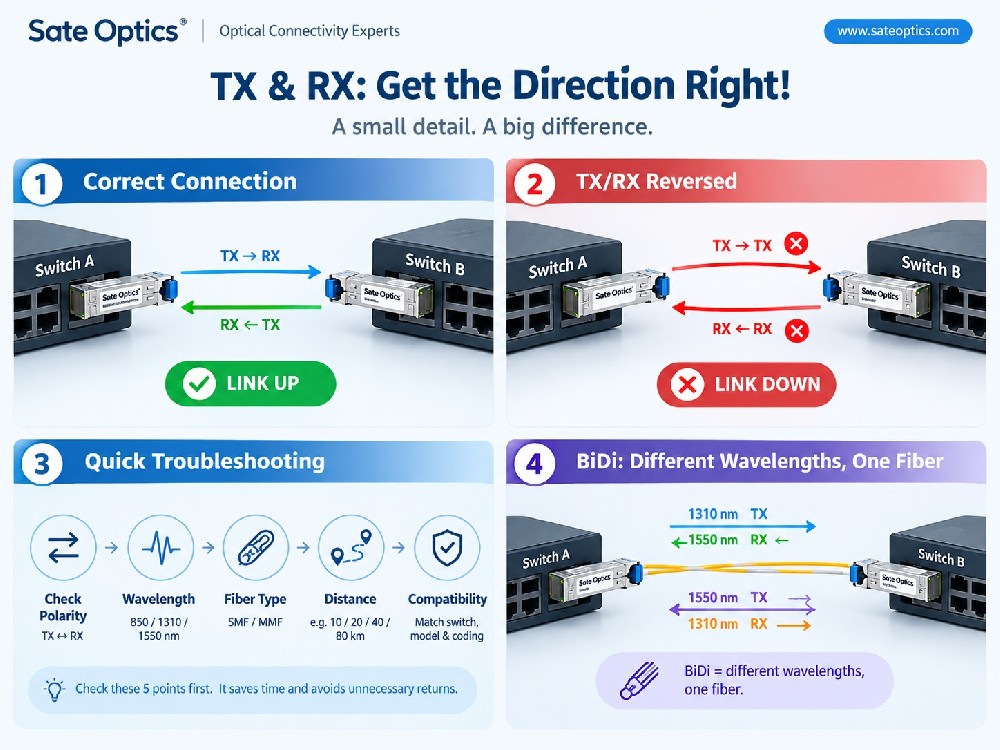
A BiDi (Bidirectional) SFP transceiver uses a single fiber to transmit and receive data.
It works by using different wavelengths:
One wavelength for transmitting
Another wavelength for receiving
Key Characteristics
Uses LC simplex connector (single fiber)
Requires a matched pair (e.g., TX 1310nm / RX 1490nm)
Saves fiber resources
Ideal for limited fiber environments
Key Differences Explained
1. Fiber Efficiency
Duplex SFP requires two fibers per link
BiDi SFP uses only one fiber
👉 This makes BiDi a strong choice when fiber resources are limited.
2. Cost Consideration
While BiDi modules are usually more expensive per unit, they can:
Reduce fiber cabling costs
Lower installation complexity
In many projects, this results in lower total cost of ownership (TCO).
3. Deployment Complexity
Duplex SFP: simple, plug-and-play
BiDi SFP: requires correct wavelength pairing
Improper pairing can result in link failure.
4. Compatibility and Use Cases
Both types can be used with equipment from vendors such as:
Cisco Systems
Juniper Networks
Arista Networks
Hewlett Packard Enterprise
However, BiDi deployments require more careful planning to ensure proper matching.
When Should You Choose Duplex SFP?
Duplex SFP is the better choice when:
Fiber infrastructure is already available
Simplicity and standardization are priorities
You want easy deployment with minimal configuration
When Should You Choose BiDi SFP?
BiDi SFP is ideal when:
Fiber resources are limited
You want to reduce cabling costs
Network expansion requires higher fiber efficiency
Choosing the Right Optical Transceiver
Selecting between Duplex and BiDi SFP depends on your:
Network architecture
Fiber availability
Budget constraints
Long-term scalability
At Sate Optics, we provide a full range of:
Duplex SFP / SFP+ / QSFP modules
BiDi optical transceivers
Solutions from 1G to 800G
All products are:
Fully tested for compatibility
Supported across major platforms
Available with fast global delivery
FAQ: Duplex vs BiDi SFP
What is the main difference between Duplex and BiDi SFP?
The main difference is fiber usage: Duplex SFP uses two fibers, while BiDi SFP uses a single fiber for bidirectional transmission.
Are BiDi SFPs compatible with Duplex SFPs?
No. BiDi SFPs must be used in matched pairs with opposite wavelengths, while Duplex SFPs use separate fibers.
Is BiDi better than Duplex?
Not necessarily. BiDi is better for saving fiber, while Duplex is simpler and more widely used.
Can I replace Duplex SFP with BiDi SFP?
Yes, but only if your fiber infrastructure supports single-fiber operation and proper pairing is implemented.
Final Takeaway
Both Duplex and BiDi SFP transceivers play important roles in modern networks.
👉 Duplex SFP offers simplicity and compatibility
👉 BiDi SFP offers fiber efficiency and cost savings
Choosing the right solution depends on your network design and operational priorities.
If you're planning a network upgrade or need help selecting between Duplex and BiDi SFP modules, our team can help.
Contact Sate Optics for:
Product recommendations
Compatibility verification
Fast quotation for your project
SFP Transceiver
Duplex SFP
BiDi SFP
Optical Transceivers
Fiber Optic Networking
Data Center Networking
Compatible Optical Modules
Fiber Optic Solutions
Network Engineering
Optical Communication
Previous:What Is Inside an SFP Transceiver? How Optical Modules Work in Fiber Networks?
Next:GPON vs XG-PON vs XGS-PON: Key Differences and How to Choose the Right PON Technology