
From Gigabit to Terabit: Understanding SFP, SFP+, QSFP, DAC, and AOC
2026-05-22 16:46:23
From Gigabit to Terabit: Understanding the Evolution of SFP, SFP+, QSFP, DAC, and AOC
As enterprise networks continue to evolve, data transmission demands are growing faster than ever. From cloud computing and AI workloads to video streaming and large-scale data centers, businesses now require higher bandwidth, lower latency, and more reliable connectivity solutions.
But when network engineers or purchasing teams look at terms like SFP, SFP+, QSFP, DAC, and AOC, the choices can quickly become confusing.
What’s the difference?
Which solution is best for short-distance connections?
When should you choose optical fiber instead of copper?
And how do you avoid compatibility or performance problems during deployment?
This article explains these technologies in a practical and easy-to-understand way.
Why Modern Networks Need Faster Interconnect Solutions
A few years ago, 1G connections were enough for most business networks. Today, many environments already operate at:
10G
25G
40G
100G
400G
Even 800G in hyperscale data centers
As network speed increases, the requirements for cabling and transceivers also change. The wrong connectivity choice can lead to:
Signal instability
Overheating
High latency
Compatibility alarms
Increased power consumption
Difficult maintenance
That’s why understanding the differences between transceiver and cable types is critical before deployment.
What Is SFP?
Small Form-Factor Pluggable (SFP)
SFP modules are compact, hot-swappable transceivers commonly used for 1G Ethernet and fiber communication.
They allow switches, routers, and servers to connect through either:
Optical fiber
Copper Ethernet
Direct attach cable solutions
Common SFP Applications
Enterprise networks
Telecom systems
Fiber access networks
Industrial networking
Advantages of SFP Modules
✅ Flexible and replaceable
✅ Supports multiple transmission distances
✅ Easy network upgrades
✅ Lower maintenance cost
What Is SFP+?
Higher-Speed 10G Connectivity
SFP+ is the enhanced version of SFP designed for 10G Ethernet applications.
Although SFP and SFP+ share a similar appearance, SFP+ supports significantly higher data rates and stricter signal requirements.
Typical SFP+ Use Cases
10G switch uplinks
Server virtualization
Storage networks
Data center aggregation
Why Many Enterprises Upgrade to SFP+
Compared with older 1G networks, SFP+ provides:
Faster file transfers
Better virtualization performance
Reduced network bottlenecks
Improved cloud workload efficiency
What Is QSFP?
High-Density High-Speed Transceivers
QSFP stands for Quad Small Form-Factor Pluggable.
Unlike standard SFP modules, QSFP solutions combine multiple transmission channels into one compact module, enabling much higher bandwidth.
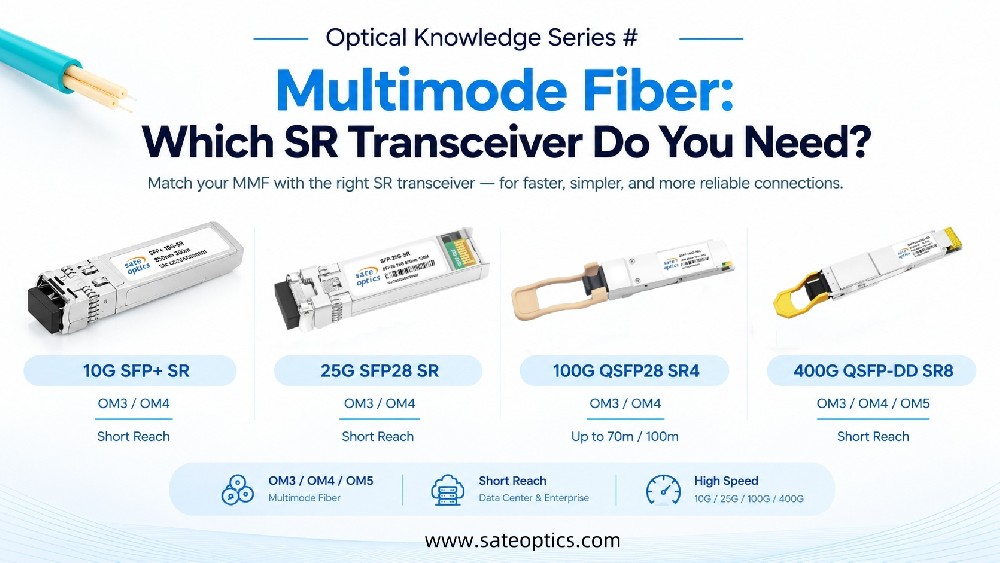
Common QSFP Types
| Module Type | Speed |
|---|---|
| QSFP+ | 40G |
| QSFP28 | 100G |
| QSFP-DD | 400G |
| OSFP | 400G / 800G |
Where QSFP Is Commonly Used
Hyperscale data centers
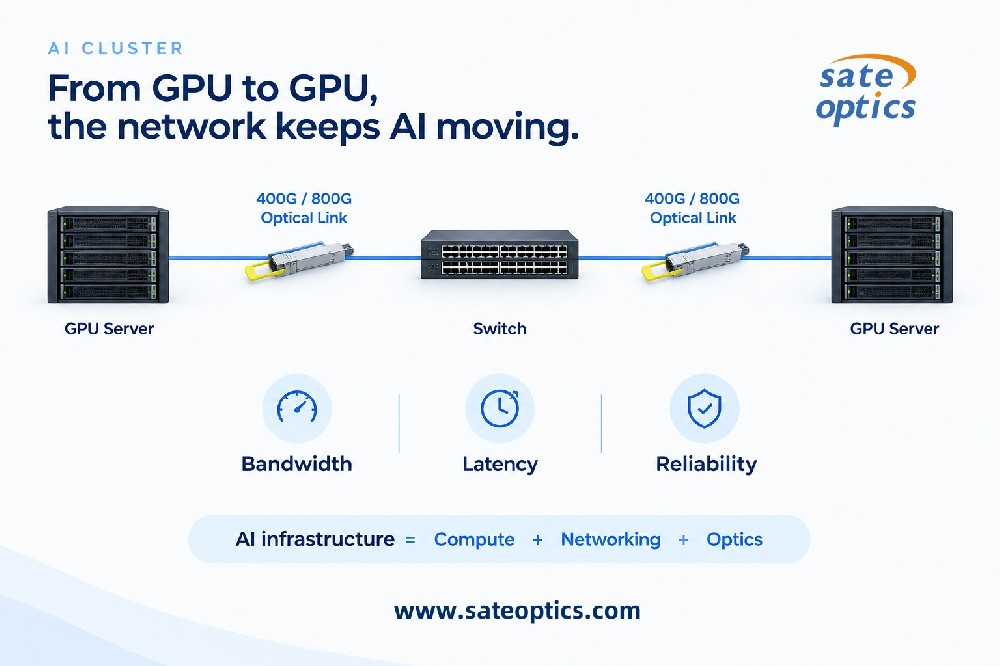
AI clusters
Spine-leaf architectures
High-performance computing environments
As AI traffic and cloud applications continue growing, QSFP-based infrastructure is becoming increasingly important.
DAC vs AOC: What’s the Difference?
This is one of the most common questions customers ask before deployment.
Although both DAC and AOC are widely used for high-speed connections, they are designed for different scenarios.
DAC (Direct Attach Copper)
DAC cables use copper conductors with fixed transceiver ends.
Best For
Short-distance rack connections
Cost-sensitive deployments
Low-power environments
Advantages
✅ Lower cost
✅ Extremely low latency
✅ Lower power consumption
✅ Simple deployment
Limitations
❌ Limited transmission distance
❌ Heavier cable management in dense racks
DAC is commonly used inside data center racks where devices are physically close together.
AOC (Active Optical Cable)
AOC combines optical fiber and transceiver technology into an integrated cable assembly.
Best For
Longer-distance connections
High-density environments
Cleaner cable management
Advantages
✅ Longer transmission distance
✅ Lightweight cable design
✅ Better airflow management
✅ Reduced electromagnetic interference
Limitations
❌ Higher cost than DAC
❌ More sensitive to bending and handling
AOC is especially useful when traditional copper solutions can no longer maintain signal integrity.
How to Choose the Right Solution
The best choice depends on several factors:
1. Transmission Distance
Very short distance → DAC
Medium to long distance → AOC or optical transceiver
2. Required Speed
1G → SFP
10G → SFP+
40G/100G/400G → QSFP series
3. Budget
DAC solutions are typically more cost-effective for short links, while optical solutions provide better scalability.
4. Equipment Compatibility
Not all switches support every module equally.
Some vendors use EEPROM validation and firmware restrictions that may trigger:
Unsupported transceiver alarms
Interface shutdowns
Link instability
This is why compatibility testing matters before large-scale deployment.
Common Mistakes Buyers Make
Many buyers focus only on price while overlooking deployment details.
Here are several issues frequently seen in real projects:
Choosing the Wrong Distance Specification
Using short-range modules for longer links often causes packet loss and unstable transmission.
Ignoring Switch Compatibility
A module may physically fit but still fail due to firmware validation.
Overlooking Heat and Power Consumption
Higher-speed modules generate more heat and require proper airflow planning.
Mixing Inconsistent Batch Quality
For large projects, maintaining stable quality consistency between samples and mass production is critical.
Why Reliability Matters More Than Ever
In modern networks, downtime is expensive.
A failed transceiver can affect:
Business communication
Cloud access
Video systems
AI workloads
Data center operations
That’s why many enterprises now prioritize:
Long-term stability
Compatibility validation
Quality consistency
Technical support responsiveness
Reliable supply chain availability
instead of simply purchasing the lowest-cost option.
The Future: From 400G to 800G and Beyond
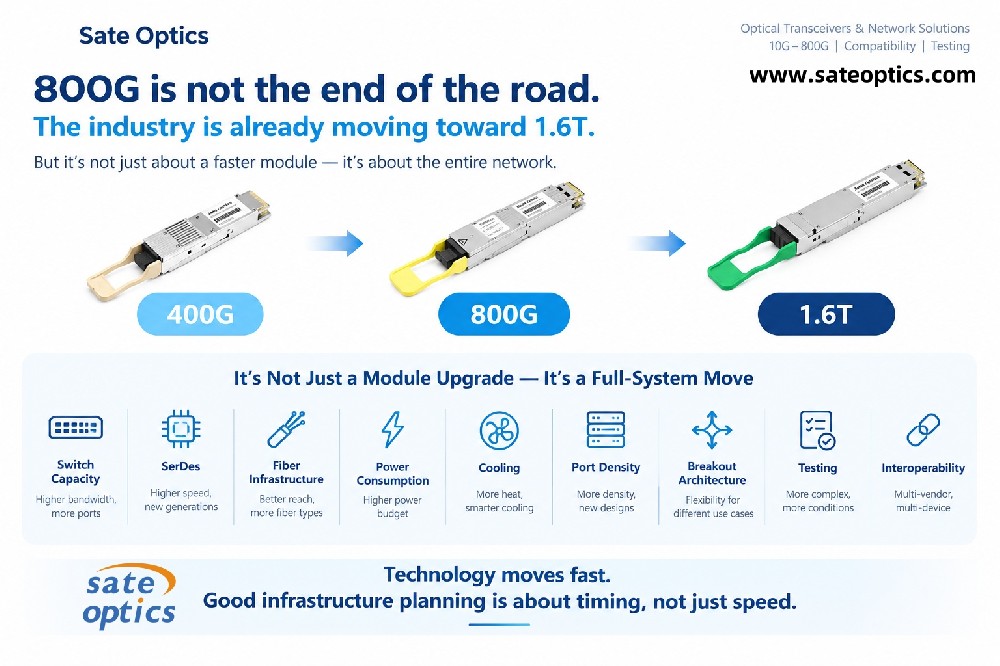
The networking industry is rapidly moving toward:
400G deployments
800G infrastructure
AI-driven traffic growth
Ultra-high-density switching
As bandwidth demands continue increasing, transceiver technology will keep evolving toward:
Higher integration
Lower power consumption
Better thermal performance
Greater transmission efficiency
The transition from gigabit to terabit networking is already happening.
Final Thoughts
Understanding the differences between SFP, SFP+, QSFP, DAC, and AOC is no longer just for network engineers. It’s essential knowledge for businesses building scalable and reliable IT infrastructure.
Choosing the right connectivity solution can help reduce operational costs, improve network stability, and prepare your infrastructure for future growth.
At Sate Optics, we provide original and compatible high-speed connectivity solutions designed for enterprise networks, telecom systems, and modern data centers.
Whether you are upgrading from 10G to 100G or preparing for 400G deployments, selecting the right interconnect technology is the foundation of long-term network performance.
FAQ
What is the difference between SFP and SFP+?
SFP typically supports 1G speeds, while SFP+ is designed for 10G Ethernet applications.
Is DAC better than AOC?
Neither is universally better. DAC is ideal for short-distance and low-cost deployments, while AOC is better for longer distances and high-density environments.
Can QSFP support 100G?
Yes. QSFP28 modules are commonly used for 100G Ethernet deployments.
Why do some switches reject third-party transceivers?
Some network vendors implement firmware validation systems that check EEPROM information inside the module.
Which solution is best for AI data centers?
High-speed QSFP-DD or OSFP optical solutions are commonly used for AI and hyperscale environments.
Explore More
🌐 Website: www.sateoptics.com
📩 Contact us for compatibility consultation and customized connectivity solutions.
SFP module, SFP+, QSFP, DAC cable, AOC cable, optical transceiver, 100G QSFP28, 400G QSFP-DD, data center networking, optical networking solutions
Next:QSFP28 vs QSFP-DD: How to Choose the Right Solution for 100G and 400G Networks