
Is Your Network Ready for 800G? Key Fiber Optic Trends Shaping Network Infrastructure in 2026
2026-06-01 21:08:55
Is Your Network Ready for 800G? Key Fiber Optic Trends Shaping Network Infrastructure in 2026
The networking industry is entering a new phase of transformation. As artificial intelligence (AI), cloud computing, machine learning, and large-scale data analytics continue to grow, traditional network architectures are facing unprecedented bandwidth demands.
In 2026, fiber optic technology will play an even more critical role in supporting modern digital infrastructure. From 800G optical transceivers to high-density cabling solutions, several key trends are shaping the future of data centers, enterprise networks, and telecommunications systems.
This article explores the most important fiber optic trends organizations should understand when planning future network upgrades.
1. 800G Optical Transceivers Are Becoming Mainstream
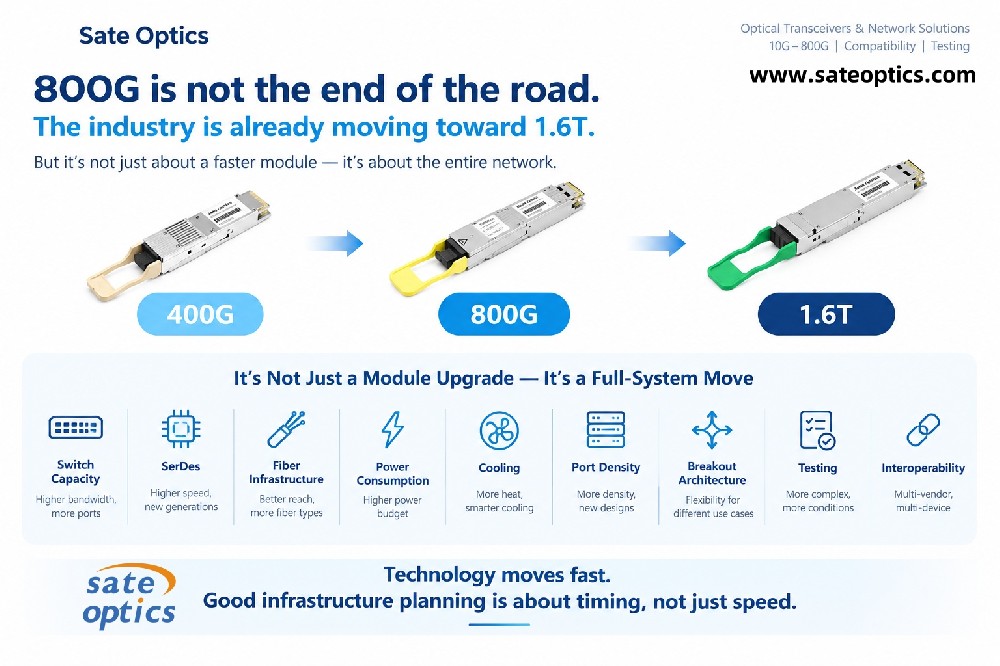
One of the most significant developments in 2026 is the increasing adoption of 800G optical connectivity.
While 400G deployments continue to expand, hyperscale data centers and AI clusters are rapidly moving toward 800G Ethernet solutions to support higher traffic volumes and lower latency requirements.
Key benefits of 800G optics include:
Increased network capacity
Improved scalability
Reduced cost per transmitted bit
Better support for AI and cloud workloads
Popular 800G form factors include:
QSFP-DD800
OSFP 800G
As deployment costs continue to decrease, 800G technology is expected to become a standard choice for next-generation network infrastructure.
2. AI Is Driving Unprecedented Bandwidth Demand
Artificial intelligence has become one of the primary drivers behind optical network upgrades.
Large AI training clusters require enormous amounts of east-west traffic between:
GPU servers
High-performance switches
Storage systems
Data center fabrics
As a result, organizations are increasingly deploying:
400G optical transceivers
800G optical modules
High-speed spine-leaf architectures
Network designs that were sufficient only a few years ago may struggle to support future AI workloads.
3. High-Density Fiber Cabling Continues to Expand
Data center operators are under constant pressure to maximize rack space while increasing network capacity.
High-density fiber infrastructure provides an effective solution by enabling more connections within a smaller physical footprint.
Technologies driving this trend include:
MPO/MTP fiber systems
High-density patch panels
Pre-terminated fiber assemblies
Structured cabling solutions
These technologies simplify deployment, improve scalability, and reduce installation time.
4. Energy Efficiency Is Becoming a Major Priority
Power consumption is no longer just an operational concern—it has become a strategic business consideration.
As network speeds increase from 100G to 400G and now 800G, equipment manufacturers are focusing on reducing energy consumption without sacrificing performance.
Modern optical transceivers offer:
Improved thermal management
Lower power consumption per gigabit
Enhanced cooling efficiency
Reduced operating costs
Energy-efficient networking will continue to be a major purchasing factor in 2026 and beyond.
5. Maximizing Existing Fiber Infrastructure
Many organizations want to increase network capacity without the significant expense of deploying new fiber.
This challenge has accelerated adoption of wavelength multiplexing technologies such as:
CWDM (Coarse Wavelength Division Multiplexing)
CWDM allows multiple optical signals to travel over a single fiber pair, increasing bandwidth while reducing infrastructure costs.
DWDM (Dense Wavelength Division Multiplexing)
DWDM provides even greater capacity and is widely used in metro, regional, and long-haul telecommunications networks.
BiDi Optical Transceivers
BiDi technology enables bidirectional communication over a single fiber strand, helping organizations maximize existing fiber resources.
These technologies continue to offer cost-effective solutions for network expansion projects.
6. Growing Demand for High-Speed Data Center Interconnect (DCI)
As enterprises deploy workloads across multiple facilities, Data Center Interconnect (DCI) solutions are becoming increasingly important.
Organizations require reliable, high-bandwidth connectivity between:
Data centers
Cloud facilities
Disaster recovery sites
Edge computing locations
Modern DCI networks increasingly rely on:
400G optical modules
800G optical solutions
DWDM platforms
Long-reach coherent optics
This trend is expected to accelerate as cloud adoption and distributed computing continue to grow.
Preparing for the Future
The future of networking is no longer defined solely by speed. Organizations must balance performance, scalability, efficiency, and cost when designing next-generation infrastructure.
Key priorities for 2026 include:
Adopting higher-speed optical technologies
Supporting AI-driven workloads
Increasing fiber density
Improving energy efficiency
Maximizing existing fiber investments
Expanding inter-data-center connectivity
Companies that proactively plan for these trends will be better positioned to support future business growth and digital transformation initiatives.
Conclusion
The transition toward 800G networking is more than a simple speed upgrade. It represents a broader shift toward AI-ready, scalable, and highly efficient network architectures.
Whether you are planning a new data center deployment, upgrading an enterprise network, or expanding telecom infrastructure, understanding these fiber optic trends can help ensure your network remains competitive in 2026 and beyond.
FAQ
What is an 800G optical transceiver?
An 800G optical transceiver is a high-speed networking module capable of transmitting up to 800 gigabits of data per second, commonly used in AI clusters, hyperscale data centers, and cloud networks.
Why is 800G becoming popular?
800G technology helps support growing bandwidth demands generated by AI applications, cloud computing, and large-scale data processing.
What is the difference between 400G and 800G optics?
800G optics provide twice the bandwidth of 400G solutions, allowing higher network capacity and improved scalability for future applications.
How does AI impact fiber optic networking?
AI workloads generate massive amounts of east-west traffic between servers, storage, and switches, increasing demand for high-speed optical connectivity.
What technologies help maximize existing fiber infrastructure?
CWDM, DWDM, and BiDi optical transceivers allow organizations to increase network capacity without deploying additional fiber cables.
Fiber Optics
Optical Transceivers
Data Center Networking
AI Infrastructure
Network Trends
Previous:QSFP28 vs QSFP-DD: How to Choose the Right Solution for 100G and 400G Networks
Next:Duplex vs BiDi Optical Transceivers: Why Do Some Modules Use Two Fibers and Others Only One?