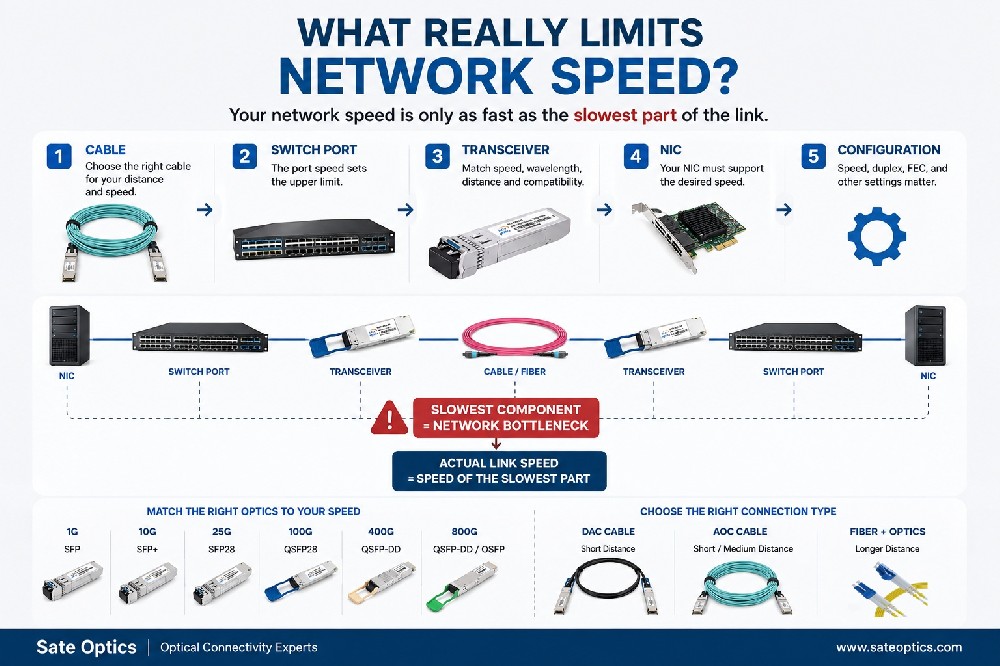

📈 Optical Transceiver Industry Trends — From 1G to 800G (What the Market Is Really Telling Us)
2025-12-31 11:49:42
📈 Optical Transceiver Industry Trends — From 1G to 800G
(What the Market Is Really Telling Us)
This image clearly shows one thing:
👉 Optical transceivers don’t just evolve — they follow real network demand.
From GBIC & SFP (1G)
to SFP+ / QSFP+ (10G–40G)
to QSFP28 / CFP2 (100G)
and now QSFP-DD & OSFP (400G–800G)
Each generation exists for one reason only:
Networks need more speed, higher density, and better efficiency.
💡 What trends can we see from this evolution?
1️⃣ Speed keeps increasing, but space stays limited
Data centers and telecom networks want higher bandwidth without expanding racks.
That’s why QSFP-DD & OSFP are replacing older large-form modules.
2️⃣ Power & heat are now critical decision factors
At 400G / 800G, performance alone is not enough.
Buyers care about:
Power consumption
Thermal design
Long-term stability
3️⃣ “Right module for the right application” matters more than ever
Not every network needs 800G.
Many customers still rely on:
10G / 25G for access networks
100G for aggregation
400G for data center spine
👉 The trend is diversification, not replacement.
🔍 What this means for buyers & integrators
Choosing optical modules is no longer about “the newest” —
It’s about matching speed, distance, cost, and reliability to your application.
That’s where real value comes in:
✔ Customized solutions
✔ Stable supply
✔ Application-based recommendations
📩 If you’re planning upgrades in data centers, telecom, or cloud networks, optical transceiver selection is the first place to optimize performance and cost.
👉 Follow us to learn how different optical modules are applied in real network scenarios, not just specs on paper.
🔖 #OpticalTransceiver #DataCenterNetworking #400G #800G #QSFPDD #OSFP #TelecomNetwork #CloudInfrastructure #FiberOptics #NetworkUpgrade #OpticalModules
Previous:🚀 Network Devices in FTTH Networks — What to Choose & Why It Matters
Next:QSFP+ | QSFP28 | QSFP-DD: Scaling Speeds from 40G to 400G